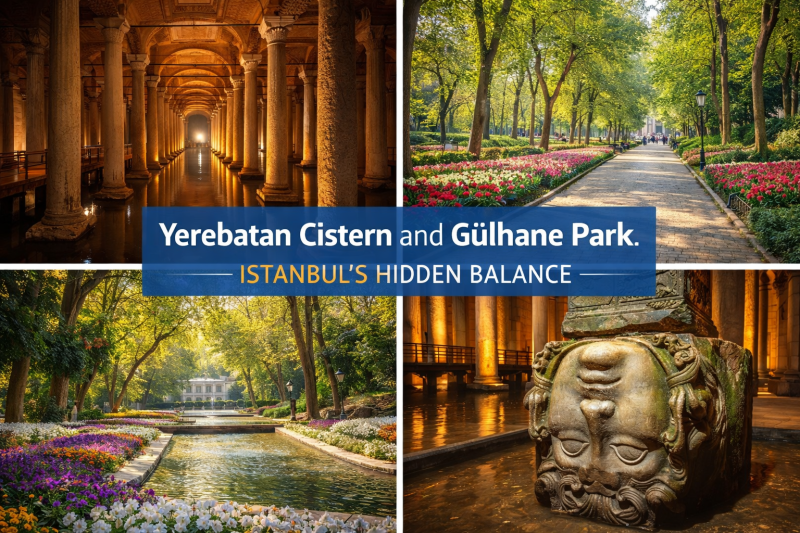
From Yerebatan to Gülhane: Stone, Water, and the Memory of Time
Yerebatan Cistern: A State Mind Built Underground
Yerebatan Cistern is a 6th-century Byzantine underground reservoir, famous for its marble columns, Medusa heads, and ancient water engineering.
https://www.google.com/maps?q=41.008385,28.977907
Some structures in Istanbul do not rise upward.
They sink deeper.
The Yerebatan Cistern is not the architecture of conquest, but the architecture of endurance.
A city is strong not by what it shows, but by what it hides.
The Yerebatan Cistern was built not merely as a water reservoir, but as a survival strategy for the Byzantine capital of Constantinople. Constructed in AD 532 during the reign of Emperor Justinian I, the cistern was designed to secure the water supply of the Great Palace complex and Hagia Sophia. The political reality of the era was clear: Constantinople was frequently besieged, and for a capital under siege, water was more critical than walls.
The cistern measures approximately 140 meters in length, 70 meters in width, and covers an area of nearly 9,800 square meters. It is the largest covered cistern in Istanbul. With a total capacity of about 80,000 cubic meters of water, the structure was never intended for daily use alone, but for long-term crisis scenarios.
Empires fall not by war, but by thirst.
Structural System and Engineering Logic
Inside the Yerebatan Cistern stand 336 marble columns, arranged in 28 rows of 12 columns each. Each column rises to a height of approximately 8–9 meters. Above them stretches a system of brick vaults that distribute weight evenly across the columns and down into the ground.
This structural design was a deliberate response to Istanbul’s high seismic risk. Vertical loads are diffused through a flexible system rather than concentrated, allowing the building to withstand earthquakes over centuries. The continued stability of the cistern after numerous major seismic events is a testament to the precision of its original calculations.
Correct calculation outlives time.
The column capitals are not uniform. Corinthian, Doric, and composite styles appear side by side. This is not decorative inconsistency, but the result of spolia, the reuse of architectural elements from earlier Roman temples and monuments. In Byzantine architecture, what mattered was not novelty, but functionality.
Waterproofing and Floor Technology
One of the most critical technical aspects of the Yerebatan Cistern is its waterproofing system. The walls and floor are coated with a special mortar known today as horasan mortar, composed of lime, crushed brick, and natural binding agents. Its ability to remain durable in constant humidity makes it one of the most advanced construction materials of its time.
The floor of the cistern is not perfectly flat. It was designed with a subtle gradient, allowing sediment to collect at specific points and keeping the water cleaner. This slope also enabled maintenance and cleaning operations during its active use.
Water stands still; engineering does not.
Water Supply and Aqueduct System
Water was brought to the cistern from the northern water basins of Istanbul, particularly from the Belgrad Forest region. A complex network of aqueducts, most famously the Valens Aqueduct, transported water across kilometers of terrain.
The entire system functioned purely on gravity. Slopes were calculated with millimetric precision. There were no pumps, no mechanical power—only mathematics, topography, and patience. This system represents a refined continuation of Roman hydraulic engineering into the Byzantine era.
Technology is sometimes silent.
The Medusa Heads: Myth or Engineering?
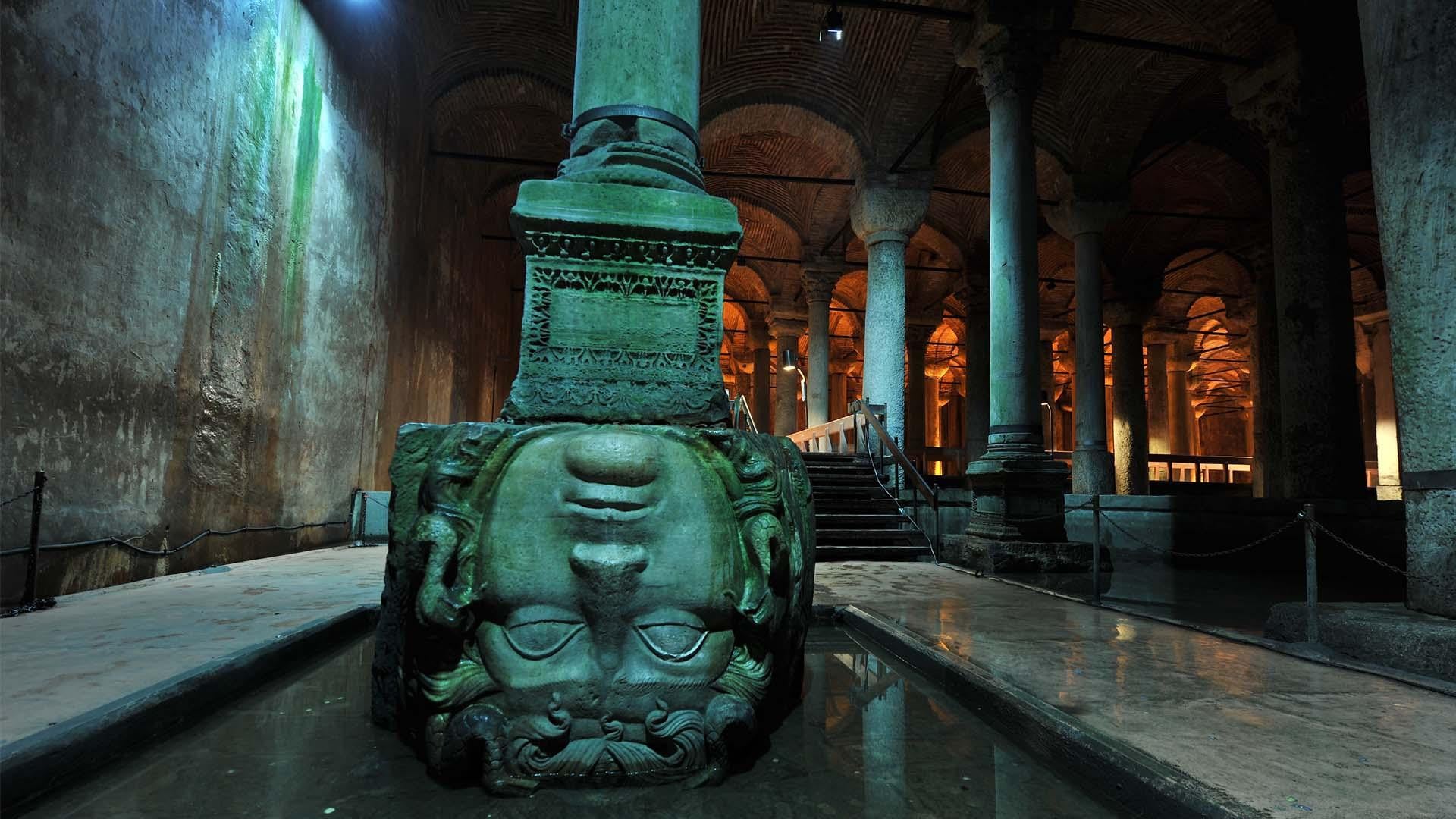
Among the most striking features of the cistern are the two Medusa heads used as column bases. One is placed sideways, the other upside down. Popular narratives often attribute mythological meanings to this arrangement, but the technical explanation is simpler: dimensional compatibility and load balance.
The sculptures were reused because they were the right size and strong enough to function as bases. Their orientation was determined by structural alignment, not symbolism. To Byzantine builders, Medusa was not a myth—it was a suitable block of stone.
Legends speak; stones carry weight.
Light, Acoustics, and Microclimate
Natural light is nearly absent inside the Yerebatan Cistern. This was a conscious design decision. Sunlight accelerates algae and bacterial growth; darkness preserves water quality. Even today, modern lighting is kept low-intensity and carefully controlled.
The acoustics of the space amplify perception. A single drop of water echoes. High humidity and enclosed volume stretch sound waves, creating the cistern’s signature atmosphere. The persistent coolness of the interior results from the thermal balance between stone, water, and air—a naturally regulated microclimate.
Darkness sometimes protects.
Yerebatan Today
Today, the Yerebatan Cistern functions as a museum, but it remains a living structure. Humidity levels, ground pressure, and micro-movements in the columns are constantly monitored by sensors. Modern conservation philosophy here does not aim to alter the building, but to allow it to continue being itself.
Yerebatan no longer stores water.
It stores time.
Some structures change function, not meaning.
Yerebatan Cistern – Frequently Asked Questions (FAQ)
Here are 10 commonly asked questions and clear answers about the Yerebatan Cistern:
1. What is the Yerebatan Cistern?
The Yerebatan Cistern is a large underground water reservoir built during the Byzantine period to supply water to imperial buildings in Constantinople.
2. When was the Yerebatan Cistern built?
It was built in 532 AD under the rule of Byzantine Emperor Justinian I.
3. Why was the Yerebatan Cistern built underground?
Being underground protected the water from enemies, heat, and contamination during times of siege.
4. How big is the Yerebatan Cistern?
It covers around 9,800 square meters and had the capacity to store about 80,000 cubic meters of water.
5. How many columns support the cistern?
There are 336 marble columns, each approximately 8–9 meters tall.
6. What is the story behind the Medusa heads?
The Medusa heads were reused as column bases and placed sideways and upside down for structural balance rather than mythological reasons.
7. Where did the cistern’s water come from?
Water was transported from the Belgrad Forest area through an advanced system of aqueducts.
8. Is the Yerebatan Cistern still used today?
No, it no longer stores water and now serves as a historical site and museum.
9. Why is it dark and quiet inside the cistern?
Low light helped keep the water clean, and the enclosed space creates a unique acoustic atmosphere.
10. Can tourists visit the Yerebatan Cistern today?
Yes, it is open to visitors and remains one of Istanbul’s most visited historical landmarks.
Walking Distances from the Basilica Cistern to Major Landmarks in Istanbul’s Historic Peninsula
The Basilica Cistern (Sultanahmet) is one of the most centrally located sites in Istanbul’s Historic Peninsula. Below are the approximate walking distances and average walking times to key landmarks:
-
Hagia Sophia: ~100 meters · 1–2 minutes
-
Blue Mosque (Sultanahmet Mosque): ~300 meters · 4–5 minutes
-
Topkapi Palace (Bab-ı Hümayun main gate): ~450 meters · 6–7 minutes
-
Gülhane Park (Sultanahmet entrance): ~500 meters · 7 minutes
-
Istanbul Archaeological Museums: ~600 meters · 8–9 minutes
-
Museum of Turkish and Islamic Arts: ~400 meters · 5–6 minutes
-
Hippodrome (At Meydanı / Obelisks): ~250 meters · 3–4 minutes
-
Binbirdirek Cistern: ~650 meters · 9–10 minutes
-
Grand Bazaar (Beyazıt entrance): ~1.2 km · 15–18 minutes
-
Sirkeci Railway Station: ~900 meters · 11–13 minutes
-
Eminönü Square: ~1.4 km · 18–20 minutes
-
Galata Bridge: ~1.8 km · 25–30 minutes
In summary: The Basilica Cistern lies at the very heart of the Hagia Sophia–Sultanahmet–Topkapi triangle, allowing visitors to reach most major landmarks of the Historic Peninsula within a 10-minute walk.
Gülhane Park: A State Garden Where an Empire Breathed
Gülhane Park is a historic green park next to Topkapı Palace, offering shaded paths, sea views, and a calm break in central Istanbul.
https://www.google.com/maps?q=41.013313,28.981867
Some green spaces in Istanbul are not parks.
They are places where time rests.
Gülhane Park is more than the outer garden of Topkapı Palace; it is an open-air record of how an empire understood nature, power, and balance.
A state is built with stone, but it breathes through trees.
Gülhane Park emerged as part of the Hasbahçe tradition of the Ottoman court system. Originally designed as the outer garden of Topkapı Palace, it functioned as a controlled landscape used by the sultan, palace officials, and court servants. This was not a public park in the modern sense; it was a semi-private space integrated into palace security, logistics, and ceremonial life.
The park’s location was chosen with precision. It lies on the sloping terrain of the Historic Peninsula, stretching toward both the Marmara Sea and the Golden Horn. This natural incline provides effective drainage, preventing water accumulation and soil erosion. Ottoman garden engineering relied on terrain rather than force, allowing gravity to work quietly and efficiently.
Correct slope is invisible comfort.
Ottoman Garden Philosophy and Landscape Design
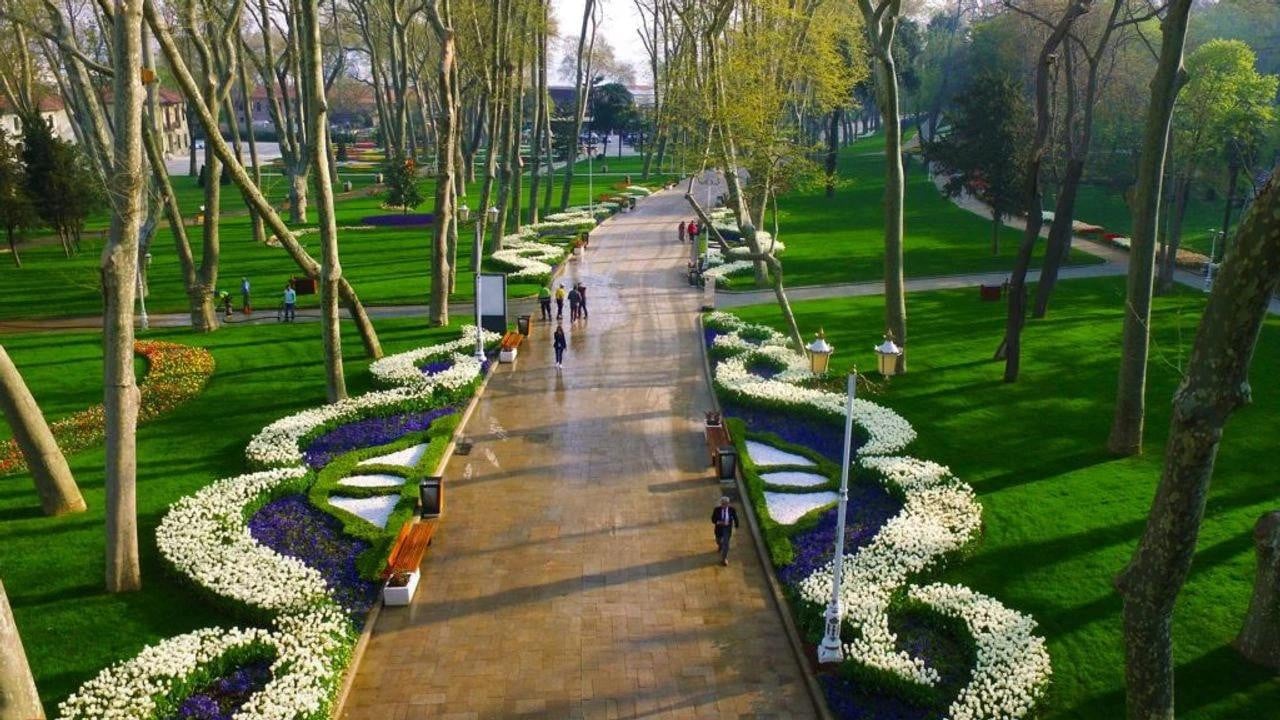
Unlike the rigid symmetry of European palace gardens, Gülhane follows a naturalistic landscape philosophy. Nature is not reshaped aggressively; it is guided. Pathways curve gently rather than cutting straight lines. Trees are grouped organically instead of aligned in strict rows. This reflects an Ottoman worldview that values harmony over dominance.
Dominant tree species include plane trees, cypresses, lindens, chestnuts, and ash trees. These long-lived species were selected for more than beauty. Their root systems stabilize the soil, their canopies provide shade, and their seasonal cycles regulate the park’s microclimate. Plane trees, in particular, create broad shaded zones that reduce surface temperature during summer months.
Shade is architecture.
Tree selection was a technical decision as much as an aesthetic one. Gülhane functions as a natural cooling zone within the dense urban fabric of Istanbul. Even in peak summer, the park remains noticeably cooler than surrounding streets, a result of canopy density and evapotranspiration.
Paths, Ground Surfaces, and Technical Infrastructure
Walking paths in Gülhane Park are not fully sealed with hard surfaces. Soil, gravel, and permeable materials are deliberately used. This allows rainwater to penetrate the ground and protects tree root systems from suffocation. Modern restoration efforts have preserved this principle rather than replacing it with concrete.
Beneath the visible landscape lies a carefully planned drainage network. Rainwater channels guide excess water without disturbing root zones. As a result, the park rarely experiences flooding despite heavy seasonal rains.
A good park never draws attention to its systems.
The gently winding paths also influence human behavior. Straight paths encourage speed; curved paths slow movement. Gülhane’s layout naturally reduces walking pace, creating a space that invites observation rather than transit. The design subtly resists urgency.
Gülhane and the Tanzimat: Reform in the Open Air
Gülhane Park holds a critical place in modern Turkish history. In 1839, the Tanzimat Edict was proclaimed here. This declaration marked the beginning of sweeping legal and administrative reforms within the Ottoman Empire. Choosing Gülhane as the setting was deliberate.
Reform was announced not behind palace walls, but in open space. Law, equality, and modernization were spoken beneath trees, in view of the city. Gülhane thus became not only a garden, but a stage of transformation.
Change sometimes begins with a location, not a document.
This moment permanently embedded political meaning into the landscape. Gülhane is not only a recreational area; it is a site of collective memory.
Palace, City, and Visual Balance
From Gülhane’s sea-facing points, the Ottoman spatial philosophy becomes visible. Palace walls, trees, sea, and sky coexist within a single frame. Power is present, but not overwhelming. Architecture does not dominate nature; it settles within it.
This visual balance reflects a broader Ottoman principle: authority should be stable, not loud. The city is not staged as a spectacle, but composed as a layered system.
Power does not shout; it positions itself.
Republican Era and Public Park Identity
During the Republican period, Gülhane Park was opened fully to the public. Accessibility increased, but the fundamental landscape structure remained intact. Benches, walking routes, and resting areas were added carefully, avoiding disruption of the original tree network.
Despite heavy daily use, the park has retained its ecological resilience. Limited hard surfaces and protected root zones allow trees to reach advanced ages compared to many urban parks. Soil compaction is controlled, and vegetation health remains high.
Concrete endures; soil lives.
Gülhane Today: A Space That Slows the City
Today, Gülhane Park functions as a balancing zone in the center of Istanbul. Tourists, students, office workers, and retirees coexist without conflict. Some walk, some sit, some simply observe. The park accommodates different speeds without forcing interaction.
Noise levels drop, movements soften, conversations lower in volume. Gülhane continues to perform its original function: reducing the city’s intensity.
A city is livable only to the extent that it can pause.
At first glance, Gülhane Park and the Yerebatan Cistern appear to be opposites. One lies underground, enclosed and dark. The other opens upward to sky and light. Yet both express the same truth: Istanbul’s strength lies not only in what it displays, but in what it preserves.
Stone holds.
Trees balance.
That is how a city survives.
GÜLHANE PARK – QUESTIONS & ANSWERS
1. What is Gülhane Park and why is it important?
Gülhane Park is a historic urban park located on Istanbul’s Historic Peninsula, directly next to Topkapi Palace. It represents the transition from imperial palace gardens to public green space in the Ottoman and early Republican periods.
2. Was Gülhane Park part of Topkapi Palace?
Yes. For centuries, Gülhane Park functioned as the outer garden of Topkapi Palace, used by the Ottoman court for recreation, ceremonies, and controlled access to the palace grounds.
3. When did Gülhane Park become a public park?
The park was opened to the public in the mid-19th century, during the Tanzimat reform era, making it one of Istanbul’s first modern public parks.
4. Where exactly is Gülhane Park located?
It lies between Sultanahmet Square, Topkapi Palace, the Golden Horn, and the Bosphorus shoreline, offering strategic views and natural airflow corridors.
5. What kind of vegetation is found in the park?
The park features mature plane trees, cypresses, lindens, chestnuts, and ash trees. Many of these are over a century old and contribute to a stable urban microclimate.
6. How does Gülhane Park affect the city’s climate?
Dense tree coverage reduces surface temperatures, increases humidity balance, and improves air quality, acting as a natural cooling zone within the city center.
7. Are there walking paths and infrastructure inside the park?
Yes. The park includes paved and semi-natural walking paths, benches, lighting, drainage systems, and small cafés, all designed to minimize ecological impact.
8. Does Gülhane Park offer sea views?
Certain sections of the park provide clear views of the Bosphorus and the Golden Horn, especially from lower elevations closer to the coastline.
9. Is Gülhane Park free to enter?
Yes. The park is open to the public free of charge and is accessible throughout the year.
10. Who uses Gülhane Park today?
It is used by locals, tourists, students, families, and office workers as a space for walking, resting, and escaping urban noise.
Walking Distances from Gülhane Park to Major Landmarks in Istanbul’s Historic Peninsula
Gülhane Park, located between Sirkeci and Sultanahmet, is one of the greenest and most centrally located areas of Istanbul’s Historic Peninsula. Below are the approximate walking distances and average walking times to the main landmarks:
-
Topkapi Palace (First Courtyard entrance): ~150 meters · 2–3 minutes
-
Istanbul Archaeological Museums: ~300 meters · 4–5 minutes
-
Hagia Sophia: ~450 meters · 6–7 minutes
-
Basilica Cistern: ~500 meters · 7–8 minutes
-
Blue Mosque (Sultanahmet Mosque): ~700 meters · 9–10 minutes
-
Hippodrome (Obelisks and historic square): ~650 meters · 8–9 minutes
-
Museum of Turkish and Islamic Arts: ~800 meters · 10–12 minutes
-
Binbirdirek Cistern: ~1 km · 13–15 minutes
-
Sirkeci Railway Station: ~400 meters · 5–6 minutes
-
Eminönü Square: ~700 meters · 9–10 minutes
-
Galata Bridge: ~1 km · 13–15 minutes
-
Grand Bazaar (Beyazıt entrance): ~1.6 km · 20–25 minutes
In summary: Gülhane Park is situated between Topkapi Palace, Hagia Sophia, and Sultanahmet, providing easy and pleasant walking access to both the Sirkeci–Eminönü area and the historic Sultanahmet district.
Timeless Istanbul Tours and Experiences
Some journeys in Istanbul are walked, others are sailed, tasted, listened to, or quietly felt. Together, these tours form a mosaic of the city’s soul—faith and celebration, empires and everyday life, land and water flowing into one another.
Hagia Sophia Ticket Sales Point opens a gentle door into one of humanity’s most layered monuments, allowing you to enter history calmly and without haste, where stone carries both prayer and silence.
https://vigotours.com/istanbul-turkey/hagia-sophia-ticket-sales-point
New Year’s Eve Dinner Cruise Party on the Bosphorus transforms the strait into a river of light, music, and renewal, where continents drift past as the year quietly changes its name.
https://vigotours.com/istanbul-turkey/new-year-s-eve-dinner-cruise-party-on-the-bosphorus-istanbul
Bosphorus Dinner Cruise offers an evening where flavors meet reflections, and Istanbul reveals itself softly through palaces, bridges, and moonlit water.
https://vigotours.com/istanbul-turkey/bosphorus-dinner-cruise
Fishing Tour in the Bosphorus of Istanbul is a slow, honest encounter with the strait, where patience replaces noise and the city watches from the shore.
https://vigotours.com/istanbul-turkey/fishing-tour-in-the-bosphorus-of-istanbul
Topkapi Palace, Hagia Sophia & More Istanbul City Tour traces the spine of empires, guiding you through courts, domes, and streets shaped by centuries of power.
https://vigotours.com/istanbul-turkey/topkapi-palace-hagia-sophia-more-istanbul-city-tour
Beylerbeyi Palace Half Day Afternoon Tour reveals an elegant pause on the Asian shore, where the Bosphorus once framed imperial leisure.
https://vigotours.com/istanbul-turkey/beylerbeyi-palace-half-day-afternoon-tour
Istanbul Byzantine Relics Half Day Morning Tour walks through the quiet remains of an earlier capital, where mosaics, columns, and walls still whisper.
https://vigotours.com/istanbul-turkey/istanbul-byzantine-relics-half-day-morning-tour
Istanbul City & Bosphorus Cruise with Dolmabahce Palace blends land and sea, ceremony and movement, inside one of the empire’s last grand residences.
https://vigotours.com/istanbul-turkey/istanbul-city-bosphorus-cruise-dolmabahce-palace
Bosphorus Istanbul Asia and Europe Full Day Tour lets you cross continents without leaving the city, stitching cultures together in a single day.
https://vigotours.com/istanbul-turkey/bosphorus-istanbul-asia-and-europe-full-day-tour
Istanbul Ottoman Relics Afternoon Half Day Tour follows the architectural handwriting of the Ottomans, written in stone, courtyards, and skyline.
https://vigotours.com/istanbul-turkey/istanbul-ottoman-relics-afternoon-half-day-tour
Day Trip from Istanbul to Bursa carries you to the green cradle of the Ottoman state, where mountains and early mosques share the same calm.
https://vigotours.com/istanbul-turkey/day-trip-from-istanbul-to-bursa
2-Day Trip to Cappadocia from Istanbul shifts the scene entirely, trading seas for valleys, and stone for sky, in a landscape shaped by time and fire.
https://vigotours.com/istanbul-turkey/2-day-trip-to-cappadocia-from-istanbul
Sapanca Lake and Masukiye Village Tour from Istanbul offers a breath of forest air, water, and quiet roads beyond the city’s edge.
https://vigotours.com/istanbul-turkey/sapanca-lake-and-masukiye-village-tour-from-istanbul
Half Day Suleymaniye Mosque & Yedikule Fortress Tour connects faith and fortification, prayer and defense, within the old city’s walls.
https://vigotours.com/istanbul-turkey/half-day-suleymaniye-mosque-yedikule-fortress-tour
Suleymaniye Mosque, Yedikule Fortress & Bosphorus Tour adds the rhythm of water to history, letting the city unfold from shore to strait.
https://vigotours.com/istanbul-turkey/suleymaniye-mosque-yedikule-fortress-bosphorus-tour
Istanbul Gallipoli Full Day Tour is a journey of remembrance, where silence, landscape, and history meet on sacred ground.
https://vigotours.com/istanbul-turkey/istanbul-gallipoli-full-day-tour
Istanbul, Cappadocia, Pamukkale & Ephesus 4-Day Tour stitches together the grand narrative of Anatolia, from myth to empire to nature.
https://vigotours.com/istanbul-turkey/istanbul-cappadocia-pamukkale-ephesus-4-day-tour
Pamukkale Tour from Istanbul by Plane carries you swiftly to white terraces and ancient pools shaped by water and time.
https://vigotours.com/istanbul-turkey/pamukkale-tour-from-istanbul-by-plane
Ephesus and Virgin Mary’s House Tour by Plane leads you through marble streets and quiet hills, where belief and history walk side by side.
https://vigotours.com/istanbul-turkey/ephesus-and-virgin-mary-s-house-tour-by-plane
Troy & Gallipoli ANZAC 2-Day Tour from Istanbul moves between legend and memory, from epic poetry to modern sacrifice.
https://vigotours.com/istanbul-turkey/troy-gallipoli-anzac-2-day-tour-istanbul
Day Trip to Troy from Istanbul brings myth closer, where walls, stories, and imagination still stand against the wind.
https://vigotours.com/istanbul-turkey/day-trip-to-troy-from-istanbul
Guided Foodie Tour on Istanbul’s European and Asian Sides tastes the city properly, one bite at a time, across kitchens, ferries, and neighborhoods.
https://vigotours.com/istanbul-turkey/guided-foodie-tour-on-istanbul-s-european-and-asian-sides
Tickets for Opera and Ballet Events in Istanbul invite you into the city’s quieter elegance, where movement and music speak without words.
https://vigotours.com/istanbul-turkey/tickets-for-opera-and-ballet-events-in-istanbul
Private Turkish Bath, Sauna and Massage Experience returns you to an older rhythm, where water, heat, and rest reset the body.
https://vigotours.com/istanbul-turkey/private-turkish-bath-sauna-and-massage-experience
Istanbul Basilica Cistern Skip-the-Line Guided Tour descends beneath the city, into a cathedral of water and shadow.
https://vigotours.com/istanbul-turkey/istanbul-basilica-cistern-a-skip-the-line-guided-tour-experience
Imperial and Hidden Treasures of Istanbul reveals what lies beyond the obvious, uncovering layers most visitors never see.
https://vigotours.com/istanbul-turkey/imperial-and-hidden-treasures-of-istanbul
Istanbul Princes’ Islands Tour leaves the city behind for quiet streets, bicycles, and sea air just offshore.
https://vigotours.com/istanbul-turkey/istanbul-princes-islands-tour
Valentine’s Day Bosphorus Dinner Cruise with Drinks Included turns the strait into a ribbon of romance, floating between lights and reflections.
https://vigotours.com/istanbul-turkey/valentine-s-day-bosphorus-dinner-cruise-with-drinks-included
Private Yacht Organization in Istanbul Bosphorus offers the most intimate way to experience the city—alone with the water and the skyline.
https://vigotours.com/istanbul-turkey/private-yacht-organization-in-istanbul-bosphorus