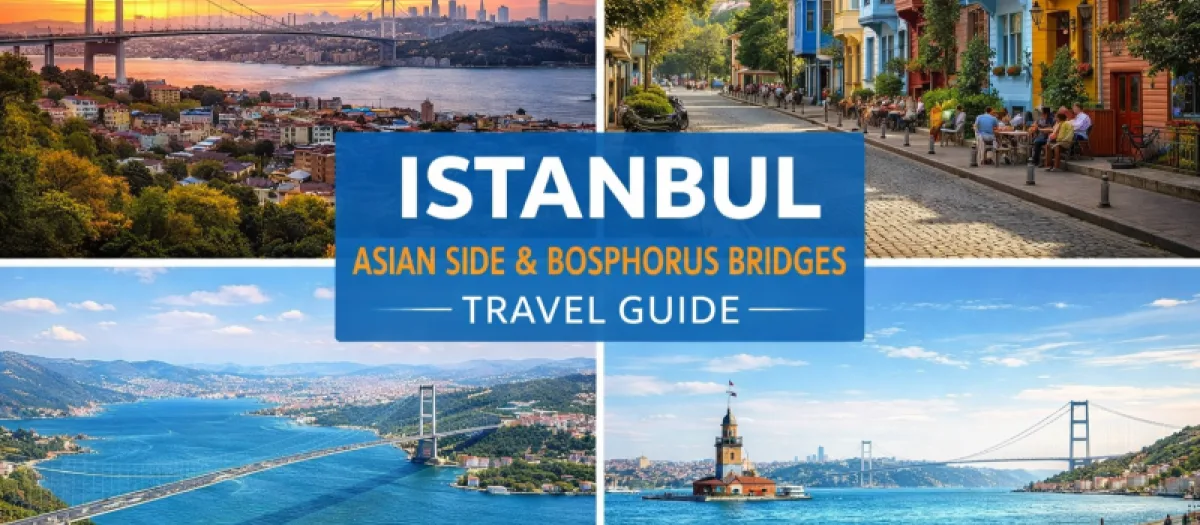
Istanbul’s Asian Side and the Bosphorus Bridges: A City Stretched Between Continents
The Eastern Face of Istanbul
Istanbul is not a single city.
It is a collection of moments layered on top of each other, a geography where continents pause before touching, and a rhythm that changes direction with the time of day. Within this vast narrative, the Asian Side is the quieter voice—but also the deeper one.
While the European Side speaks loudly with monuments, crowds, and spectacle, the Asian Side tells its story slowly. It does not rush to impress. It waits. It remembers. It breathes.
Facing east, this side of the city receives the first light of morning. As the sun rises behind the hills of Çamlıca, the Bosphorus reflects steel-colored light, and the bridges appear not merely as structures, but as suspended sentences connecting different chapters of the same story.
The Geographic and Urban Identity of the Asian Side
The Eastern Spine of the Bosphorus
The Asian Side forms the eastern backbone of the Bosphorus, stretching from the Black Sea in the north to the Marmara Sea in the south. Along this coastline—from Üsküdar to Beykoz—lie some of Istanbul’s oldest settlement layers.
Historically, this was not a place of passing through, but a place of arrival.
Üsküdar: The Threshold of Anatolia
Üsküdar stands as the historical heart of Istanbul’s Asian Side. For centuries, it served as the gateway to Anatolia, the point where land routes met the sea. Its mosques, ferry docks, and waterfront streets form a natural hinge between continents.
Here, the city does not confront the water—it converses with it.
Kadıköy: The Pulse of Modern Time
Kadıköy represents the contemporary soul of the Asian Side. Yet its modernity is layered, not superficial. From ancient Chalcedon to today’s vibrant cultural life, Kadıköy carries continuity rather than rupture.
It is a district where the Asian Side is not only lived in, but actively produced—through art, daily routines, and urban culture.
The Bosphorus Bridges: Steel Turned into Poetry
Structures That Unite Continents
The bridges of the Bosphorus are more than transportation infrastructure. They are thresholds—points where engineering meets aesthetics, and where movement becomes meaning.
From the perspective of the Asian Side, these bridges are grand gates opening the city outward.
July 15 Martyrs Bridge (First Bosphorus Bridge)
https://maps.app.goo.gl/HWs2UaiahUkA2wNv7
Opened in 1973, this was Istanbul’s first permanent road connection between Europe and Asia. Anchored on the Asian Side near Beylerbeyi and Üsküdar, it changed the city irreversibly.
Technically, it is a suspension bridge with a main span of 1,560 meters. Symbolically, it marked the moment when the Asian Side ceased to be “across” and became “within.”
Fatih Sultan Mehmet Bridge (Second Bridge)
https://maps.app.goo.gl/Wa9Thn9KgxQVwrsm6
Completed in 1988 further north, this bridge connects Europe to the Asian Side through Kavacık. Its impact was expansive rather than symbolic.
With this bridge, the city began to grow northward. Forested hills, slopes, and once-quiet districts on the Asian Side were gradually woven into Istanbul’s daily life.
Yavuz Sultan Selim Bridge (Third Bridge)
https://maps.app.goo.gl/4owmBcWYCU3d6N1F7
The northernmost crossing, carrying both road and rail traffic, represents Istanbul’s most advanced engineering achievement. Located within the borders of Beykoz on the Asian Side, it is part of a much larger logistical system.
This bridge does not only connect two sides of a city—it integrates Istanbul into regional and global transit networks.
Transportation from the European Side to the Asian Side
Crossing by Road, Rail, and Sea
Movement between Europe and Asia defines Istanbul’s daily rhythm. These crossings do not merely transport people—they transport emotions, habits, and time.
Road Transport via the Bridges
Private vehicles and buses use all three Bosphorus bridges. Traffic flows are directional: mornings favor Europe-to-Asia, evenings reverse the pattern.
This daily migration proves that Istanbul is a city that literally changes direction with the clock.
Rail Transit: Marmaray
Marmaray runs beneath the Bosphorus, quietly redefining urban mobility. Trains departing from European stations such as Yenikapı and Sirkeci arrive at Üsküdar and Ayrılık Çeşmesi on the Asian Side.
Unlike the bridges above, this passage is invisible—yet transformative. The city flows under water, uninterrupted.
Sea Routes: Ferries and Sea Buses
Ferries remain the most poetic way to cross. Boats departing from Eminönü, Beşiktaş, and Karaköy arrive at Üsküdar and Kadıköy.
This is not simply transportation. It is a ritual—a pause between two worlds.
The Hills and Quiet Shores of Istanbul’s Asian Side
Reading the City from Above
To understand the Asian Side of Istanbul, it is not enough to walk along the shoreline. This side of the city reveals its true character from higher ground. Istanbul speaks most clearly when observed from its hills—when distance creates clarity.
The Çamlıca Hills: Istanbul’s Breathing Space
Great Çamlıca and Little Çamlıca rise above the Asian Side like natural observation towers. From here, the Bosphorus appears not as a strait, but as a line of time. The European Side stretches across the water, and the bridges hang between continents like suspended thoughts.
From a technical perspective, Çamlıca remains one of the least densely built high elevations in Istanbul. This preserved openness contributes greatly to the Asian Side’s reputation for livability.
From a human perspective, it offers something rarer: pause.
The Slopes of Beykoz: Where City Meets Forest
Beykoz represents the most intimate encounter between nature and urban life on the Asian Side. Residential areas descend sharply toward the Bosphorus, while forests rise quietly behind them.
Here, the city is shaped not by grids or wide avenues, but by slope and gravity. Streets curve, perspectives shift, and the Bosphorus appears suddenly—unexpected and close.
This geography slows movement, and in doing so, reshapes daily life.
The Shoreline: A Slower Version of Istanbul
The Rhythm of the Coast
Unlike the European Side, where waterfronts often function as corridors, the Asian Side’s coastline is a place to remain. The shore here invites stillness rather than transit.
Üsküdar Waterfront: Where Time Expands
Üsküdar’s shoreline is one of the most restrained yet powerful spaces in the city. Ferries approach calmly. The Maiden’s Tower waits offshore. People sit without urgency.
This stretch of coast does not compete for attention. It holds it.
The Asian Side reveals itself here most clearly: understated, reflective, and deeply rooted.
Kadıköy to Moda: The Inner Energy of the City
Moda’s coastline faces the Marmara Sea rather than the Bosphorus. The horizon opens wider, the water feels freer, and the city’s energy turns inward.
From a planning perspective, this area is one of Istanbul’s most actively used pedestrian waterfronts.
Yet the activity produces rhythm, not noise.
Life here moves forward without needing to prove itself.
How the Bridges Transformed the Asian Side
Infrastructure as a Turning Point
For the Asian Side, the Bosphorus bridges represent not just connection, but transformation. Each bridge altered how this side of the city related to growth, identity, and function.
After the First Bridge
With the opening of the July 15 Martyrs Bridge, Üsküdar and its surroundings were pulled decisively into Istanbul’s urban core.
The Asian Side was no longer perceived as “the other side,” but as part of the city’s center.
This shift changed real estate patterns, daily commuting habits, and social perception.
The Second Bridge and Northern Expansion
The Fatih Sultan Mehmet Bridge redirected growth northward. Areas such as Kavacık, Ümraniye, and later Ataşehir expanded rapidly.
This period marked the Asian Side’s transition from a primarily residential zone into a multifunctional urban environment—combining housing, employment, and infrastructure.
The Third Bridge and the Regional Scale
The Yavuz Sultan Selim Bridge repositioned the Asian Side within a much larger framework.
It connected Istanbul not only internally, but externally—to logistics, freight corridors, and international movement.
At this scale, the Asian Side became a structural component of the city’s future.
Daily Life Between Europe and Asia
A City That Changes Direction
Traffic in Istanbul is not defined solely by congestion—it is defined by flow.
In the mornings, movement favors Europe-to-Asia. In the evenings, it reverses.
Work, Education, and Balance
The growth of business districts on the Asian Side—particularly around Ataşehir and Ümraniye—has altered this pattern. The Asian Side is no longer only a place to return to at night.
It is a place to begin the day.
This balance has softened pressure on bridges and rail systems while strengthening the Asian Side’s independence.
Neighborhood Life and Urban Memory on the Asian Side
Small Stories Within a Vast City
What truly distinguishes Istanbul’s Asian Side is scale.
Here, it is still possible to live a human-sized life within one of the world’s largest cities. Neighborhood culture is not nostalgia—it is daily reality.
Üsküdar’s Neighborhoods: Geography of Continuity
Districts such as Bağlarbaşı, Kuzguncuk, and Selimiye preserve a sense of continuity rarely found in global cities. Wooden houses, modest local shops, and quiet cafés form an urban fabric that resists erasure.
In these neighborhoods, the city slows down.
Istanbul does not rush here—it walks.
Kadıköy’s Inner Streets: Layered and Alive
Kadıköy’s center is dynamic, but its deeper character lives in the back streets. Yeldeğirmeni and Rasimpaşa are spaces where memory and transformation coexist.
Here, old structures are not replaced—they are absorbed.
Change does not overwrite history; it leans against it.
The Asian Side as a Walkable Discovery
Understanding the City on Foot
The Asian Side is not designed for speed. It is designed for attention.
To explore it properly, one must walk.
Coastal Paths and Inner Streets
The walking route from Üsküdar to Kuzguncuk offers one of Istanbul’s calmest urban experiences. The Bosphorus is not scenery here—it is accompaniment.
In Kadıköy, movement flows inward from the coast. The path from Moda to Bahariye Avenue reveals the city’s social spine, shaped by pedestrians rather than vehicles.
Slopes, Elevation, and Perspective
The Asian Side is defined by elevation.
Its hills and slopes prevent monotony and reward effort.
Each incline opens a new angle of the city. Each descent returns the observer to water, to movement, to life.
Exploration here is never linear. It is intuitive.
The Psychology of the Asian Side
Why It Feels Calmer
Physically, the Asian Side is not less dense than the European Side.
Psychologically, it feels profoundly different.
This difference emerges from how space is used, not how much of it exists.
Less Display, More Presence
Public spaces on the Asian Side are not stages.
Cafés, squares, and waterfronts are not designed to be seen—they are designed to be occupied.
As a result, crowds form without tension. Movement occurs without urgency.
Living Beneath the Bridges, Without Their Weight
Although the Bosphorus bridges pass overhead, they do not dominate the Asian Side’s identity.
Here, bridges are perceived as opportunities rather than pressures.
The feeling of being trapped between continents—a common sensation elsewhere in Istanbul—is noticeably weaker on this side of the city.
Balance with the European Side
Crossing as Choice, Not Obligation
Living on the Asian Side does not require dependence on the European Side.
Bridges and rail systems make crossing easy—but not mandatory.
This freedom is central to the Asian Side’s appeal.
The city does not demand allegiance here. It allows preference.
The Future of the Asian Side and the Bosphorus Bridges
A City That Moves Forward Without Losing Itself
In Istanbul, the future is never built from scratch.
It is layered carefully on top of what already exists. The Asian Side and the Bosphorus bridges embody this principle more clearly than any other part of the city.
One is grounded, patient, and inward-looking.
The others are elevated, tensile, and constantly in motion.
Together, they form a system where speed and stillness coexist.
As transportation networks expand, tunnels deepen, and rail lines multiply, the Asian Side absorbs progress without surrendering its character. Growth arrives—but it does not erase.
Bridges and the Changing Direction of the City
From Event to Habit
When the Bosphorus bridges were first built, they were moments of rupture—spectacles of engineering and ambition. Today, they are habits.
Yet habit does not mean insignificance.
Integrated Transportation Systems
With Marmaray, the Eurasia Tunnel, and the expanding metro network, the Asian Side is no longer defined by separation.
From a technical standpoint, travel times have shortened, pressure on surface traffic has eased, and accessibility has improved dramatically.
From a human standpoint, something subtler has occurred:
The Asian Side has gained confidence.
Europe is no longer the center to which everything points. It is simply another direction.
The Quiet Burden of the Bridges
At night, the bridges glow.
Their lights stretch across the Bosphorus like constellations brought down to earth.
Yet on the Asian Side, this illumination does not feel invasive. The city absorbs the light without noise. The bridges pass overhead—but they do not impose.
This balance is rare in megacities.
The Asian Side’s Relationship with Time
A Different Pace of Urban Life
Time behaves differently on the Asian Side.
The same hour carries a different weight.
Mornings and Evenings
Mornings begin earlier along the Bosphorus-facing neighborhoods. Light arrives first, and with it, a sense of quiet anticipation.
Evenings settle sooner. The city winds down deliberately, not out of exhaustion but out of choice.
On the Asian Side, days are not consumed.
They are completed.
Places That Remember
A bench by the water.
A corner at the top of a hill.
A street that curves just enough to hide what comes next.
On the Asian Side, places are designed to be remembered. This transforms the city from a backdrop into a companion.
Between Continents, Yet Complete
What Makes the Asian Side Enduring
The Asian Side does not reject the rest of Istanbul.
But it does not surrender to it either.
It understands the energy of the European Side, acknowledges its intensity, and then chooses another way of being. Bridges provide access—but not dependence.
Here, the city does not pull you in.
It walks beside you.
Haydarpaşa Train Station
https://maps.app.goo.gl/eRZbuYNEwJhyHjYM8
A Gate of Stone, a Threshold of Time
Haydarpaşa Train Station is not merely a building; it is a stone gateway where Anatolia meets Istanbul, a silent threshold between eras. Rising by the sea in 1908, it stood as train whistles blended with the sound of waves, bearing witness to departures, reunions, and countless journeys. At the entrance of the Bosphorus, Haydarpaşa has watched over Istanbul for more than a century.
Destinies Carried on Iron Rails
Every train arriving at Haydarpaşa carried more than passengers—it brought hope, longing, and fate. It was the first step into Istanbul for generations coming from Anatolia, the place where dreams met reality. Heavy suitcases, tearful farewells, quiet excitement, and unspoken fears all shared the same platforms, etched into stone and memory.
An Architecture That Speaks to the Sea
Built in Neo-Renaissance style, the station rises as if in dialogue with the sea. Its towers, designed by German architects, stand firm against the Bosphorus winds, projecting strength and dignity. At sunset, its walls glow with warm colors; at dawn, they fade into mist, forming one of Istanbul’s most poetic silhouettes.
Silence Filled with Memories
After the fire of 2010, the trains fell silent, but Haydarpaşa did not. Its walls continue to whisper stories of the past, and even without rails, footsteps seem to echo across the platforms. Today, it stands less as an active station and more as a monument of memory, holding time itself within its stones.
An Epic Watch at the Heart of Istanbul
Facing Anatolia, Haydarpaşa Train Station keeps an epic vigil at the edge of the city. Even without trains, it waits—guarding the past, the future, and Istanbul’s never-ending story. Because Haydarpaşa is not just a station; it is the way Istanbul remembers itself.
An Epic Closing: The Value of Staying
Istanbul is a city that speaks loudly.
But the Asian Side whispers.
Thousands cross the Bosphorus every day—by bridge, by rail, by water. Some cross in haste, some out of routine.
But those who remain on the Asian Side understand something essential:
The true meaning of this city is not in crossing.
It is in staying.
This side of Istanbul is
Between continents, yet balanced within itself.
Surrounded by movement, yet internally still.
Close to everything, yet not consumed by anything.
And perhaps that is why, once chosen,
The Asian Side is the hardest part of Istanbul to leave.
Istanbul Asian Side & Bosphorus Bridges – 50 Frequently Asked Questions
What is the Asian Side of Istanbul and why is it special?
The Asian Side of Istanbul, also known as Anatolian Side, offers a calmer, more local atmosphere compared to the European Side. It is rich in daily life, seaside neighborhoods, traditional markets, green parks, and authentic dining spots that tourists often miss.
Is the Asian Side of Istanbul worth visiting for tourists?
Yes, the Asian Side is absolutely worth visiting, especially for travelers seeking authentic Istanbul experiences. It provides scenic waterfront walks, historic districts like Üsküdar and Kadıköy, and fewer crowds than the European landmarks.
What are the main districts on Istanbul’s Asian Side?
Kadıköy, Üsküdar, Ümraniye, Ataşehir, Beykoz, and Maltepe are the most notable districts. Each area offers different experiences, from nightlife and food culture to historical mosques and Bosphorus viewpoints.
Which Asian Side neighborhood is best for first-time visitors?
Kadıköy is the best starting point for first-time visitors. It has excellent transport links, vibrant streets, cafes, markets, seaside promenades, and a youthful cultural scene that reflects modern Istanbul.
Is Kadıköy safe for tourists at night?
Kadıköy is considered one of the safest and liveliest areas in Istanbul at night. Streets are busy, restaurants stay open late, and public transport operates smoothly, making it comfortable for visitors to explore after dark.
What can tourists do in Üsküdar?
Üsküdar is ideal for history lovers and photographers. Visitors can explore Ottoman-era mosques, walk along the Bosphorus coast, enjoy ferry views, and experience a more traditional, spiritual side of Istanbul.
Are there historical sites on the Asian Side of Istanbul?
Yes, the Asian Side hosts significant historical sites including Mihrimah Sultan Mosque, Beylerbeyi Palace, Çamlıca Hill mosques, and centuries-old seaside districts that reflect Istanbul’s Ottoman heritage.
What is Çamlıca Hill famous for?
Çamlıca Hill is famous for offering one of the highest panoramic views of Istanbul. From here, visitors can see the Bosphorus, both continents, and all major bridges, especially stunning at sunset.
Can you see Bosphorus bridges from the Asian Side?
Yes, the Asian Side offers some of the best viewpoints of the Bosphorus bridges, particularly from Çamlıca Hill, Üsküdar coastline, and Beykoz areas, where the bridges frame the skyline beautifully.
How many Bosphorus bridges are there in Istanbul?
Istanbul has three major Bosphorus crossings: the 15 July Martyrs Bridge, Fatih Sultan Mehmet Bridge, and Yavuz Sultan Selim Bridge, each connecting Europe and Asia with different purposes and routes.
What is the oldest Bosphorus bridge?
The 15 July Martyrs Bridge, formerly known as the Bosphorus Bridge, is the oldest. Opened in 1973, it symbolized Istanbul’s modern connection between Europe and Asia for the first time.
What is the Fatih Sultan Mehmet Bridge used for?
The Fatih Sultan Mehmet Bridge mainly serves transit traffic and heavy vehicles. It is located further north and helps reduce congestion on the central Bosphorus Bridge by handling long-distance and commercial transport.
What makes the Yavuz Sultan Selim Bridge unique?
The Yavuz Sultan Selim Bridge is one of the widest and tallest bridges in the world. It carries road traffic, rail systems, and heavy trucks, playing a critical role in Istanbul’s northern transport network.
Are Bosphorus bridges pedestrian-friendly?
No, pedestrian access is not allowed on Bosphorus bridges for safety reasons. However, visitors can enjoy the bridges via ferries, viewpoints, boat tours, and scenic coastal walks.
Is crossing the Bosphorus bridge free?
No, crossing the Bosphorus bridges is not the same for all bridges. On the 15 July Martyrs Bridge and the Fatih Sultan Mehmet Bridge, tolls are charged only in one direction, from the European Side to the Asian Side. Crossings from Asia to Europe are free on these two bridges.
However, the Yavuz Sultan Selim Bridge is an exception: it is toll-charged in both directions, meaning drivers pay when crossing from Europe to Asia and from Asia to Europe. This difference is often misunderstood by tourists and first-time visitors to Istanbul.
Can tourists use ferries instead of bridges?
Yes, ferries are one of the most enjoyable ways to cross the Bosphorus. They offer scenic views, affordable prices, and an authentic Istanbul experience connecting Asian and European districts.
Which ferry routes connect the Asian Side to Europe?
Popular ferry routes include Kadıköy–Eminönü, Üsküdar–Beşiktaş, and Kadıköy–Karaköy. These routes are frequent and operate daily, making them ideal for tourists.
Are ferries included in Istanbul public transport?
Yes, ferries are part of Istanbul’s integrated public transport system. Visitors can use Istanbulkart on ferries just like buses, metros, trams, and Marmaray trains.
What is Marmaray and how does it connect Asia and Europe?
Marmaray is an underwater rail tunnel connecting Asia and Europe beneath the Bosphorus. It provides fast, reliable transportation and is especially useful during rush hours or bad weather.
Is Marmaray tourist-friendly?
Yes, Marmaray is easy to use for tourists. Stations are well-marked, trains are modern, and announcements are bilingual, making it a convenient way to cross continents quickly.
Which Asian Side areas are best for food lovers?
Kadıköy is the culinary heart of the Asian Side, offering street food, seafood, traditional Turkish dishes, and international cuisine. Üsküdar also has excellent local eateries with Bosphorus views.
Are there beaches on Istanbul’s Asian Side?
Yes, the swimmable beaches on Istanbul’s Asian Side are mainly located in the Şile and Ağva area, along the Black Sea coast. These areas offer natural sandy beaches and suitable sea conditions for swimming, especially during summer.
The urban coastline of the Asian Side does not have proper beaches for sea swimming. Visitors who want to swim should plan their trip specifically toward Şile and its surroundings, rather than the inner city shoreline.
What are the Princes’ Islands and how to reach them?
The Princes’ Islands are a group of car-free islands in the Sea of Marmara. Ferries depart from Kadıköy and Bostancı, making them perfect for a peaceful day trip from the Asian Side.
Is the Asian Side greener than the European Side?
Generally yes. The Asian Side has more parks, forests, and open spaces such as Beykoz forests and coastal promenades, offering a quieter and more nature-oriented environment.
Which Asian Side area is best for shopping?
Kadıköy offers local markets, boutiques, and shopping streets, while Ataşehir and Ümraniye have modern shopping malls with international brands and entertainment facilities.
Is nightlife active on the Asian Side?
Nightlife is vibrant in Kadıköy, especially around Moda and Barlar Sokağı. It features live music venues, bars, and cafes, offering a more relaxed alternative to European Side nightlife.
Can tourists stay on the Asian Side?
Yes, many tourists choose the Asian Side for accommodation due to lower prices, calmer neighborhoods, and good transport connections to major attractions across the city.
How long does it take to reach European landmarks from Asia?
Depending on transport choice, it usually takes 15–40 minutes to reach European landmarks using ferries, Marmaray, or metro connections from the Asian Side.
Is traffic heavy on Bosphorus bridges?
Traffic congestion is common during rush hours, especially on weekdays. Visitors are advised to use ferries or rail systems to avoid delays when crossing continents.
Are Bosphorus bridges illuminated at night?
Yes, the bridges are beautifully illuminated at night, creating iconic city views. Evening boat tours and coastal walks offer excellent opportunities to enjoy these lights.
What is the best time to photograph Bosphorus bridges?
Sunset and nighttime are ideal for photography. Golden hour highlights the water and skyline, while night lighting emphasizes the bridge structures against the city backdrop.
Do Bosphorus bridges close during special events?
Occasionally, bridges may close temporarily for marathons, national celebrations, or official events. These closures are announced in advance by local authorities.
Are Bosphorus bridges earthquake-resistant?
Yes, Istanbul’s bridges are designed with advanced engineering standards and have undergone reinforcements to improve earthquake resistance due to the region’s seismic risk.
Can you take boat tours under the bridges?
Yes, many Bosphorus cruises pass directly under the bridges. This perspective allows visitors to appreciate their scale and architectural design from the water.
Which Asian Side areas offer Bosphorus views?
Üsküdar, Beylerbeyi, Kandilli, and Beykoz provide stunning Bosphorus views. These areas are ideal for waterfront walks, photography, and relaxing cafes.
Is Beylerbeyi Palace on the Asian Side?
Yes, Beylerbeyi Palace is located on the Asian Side near the Bosphorus Bridge. It served as an Ottoman summer palace and is open to visitors today.
How is public transport on the Asian Side?
Public transport is efficient and modern, including metro lines, buses, ferries, Marmaray, and minibuses. Istanbulkart works across all transport options seamlessly.
Are Asian Side attractions crowded?
Generally, attractions on the Asian Side are less crowded than European landmarks, making sightseeing more relaxed and enjoyable, especially during peak tourist seasons.
Is the Asian Side suitable for families?
Yes, it is very family-friendly with parks, wide promenades, playgrounds, museums, and calmer streets compared to central tourist zones.
What is Moda and why is it popular?
Moda is a stylish neighborhood in Kadıköy known for cafes, seaside parks, art spaces, and sunset views. It attracts locals, creatives, and visitors seeking a relaxed vibe.
Are there cultural events on the Asian Side?
Yes, the Asian Side hosts concerts, theater performances, exhibitions, and festivals, particularly in Kadıköy and Üsküdar cultural centers throughout the year.
What makes the Asian Side different from the European Side?
The Asian Side feels more residential, authentic, and peaceful. It offers insight into daily Istanbul life, contrasting with the tourist-heavy and historical focus of the European Side.
Should tourists include the Asian Side in their Istanbul itinerary?
Absolutely. Including the Asian Side adds depth to an Istanbul trip, balancing iconic landmarks with local culture, scenic views, and a slower, more genuine city experience.
Istanbul Tours and Asian Side Pick-Up & Drop-Off Policy
Please note that pick-up and drop-off services from Istanbul’s Asian Side (Anatolian Side) are not available for Istanbul tours. Due to traffic conditions, Bosphorus crossings, and operational timing, all Istanbul daily tours operate only from the European Side.
The designated meeting and pick-up/drop-off point for Istanbul tours is in front of Sirkeci Train Station. Sirkeci is a central and easily accessible location with excellent public transportation connections. Guests staying on the Asian Side can reach Sirkeci conveniently by Marmaray, ferry services, or other public transport options.
You can view all available Istanbul tours and daily activities using the link below:
https://vigotours.com/things-to-do/daily-tours-activities/istanbul-turkey/all-categories
This policy applies to all Istanbul tours listed on our website.