Non-Islamic Historical Sites in Istanbul: Roman, Byzantine, Christian and Jewish Heritage
Istanbul is often associated with its magnificent Ottoman mosques, palaces and Islamic heritage. Yet the history of the city began many centuries before the Ottoman conquest of Constantinople in 1453.
Ancient Greek settlements, Roman emperors, Byzantine Christianity, Genoese merchants, Sephardic Jewish communities and European religious orders have all left visible traces across modern Istanbul.
For travellers interested in exploring these different layers of the city, Istanbul offers an extraordinary collection of Roman monuments, Byzantine churches, underground cisterns, Christian sanctuaries, synagogues, archaeological collections and medieval fortifications.
Many of them are concentrated around Sultanahmet, Fatih, Fener, Balat, Galata and Beyoğlu, which means several important sites can be combined within the same day.
Visitors who want a broader introduction to the city can also browse the complete selection of Istanbul tours and activities.
Roman and Byzantine Heritage in Istanbul
Long before the Ottoman period, Constantinople was one of the most important cities of the Roman and Byzantine worlds.
Emperor Constantine I transformed Byzantium into Constantinople in the fourth century, and the city later became the political, religious and cultural centre of the Eastern Roman Empire.
Much of this history remains visible today.
Hippodrome of Constantinople
Location: Sultanahmet Square, Fatih
Visiting days: Every day
The Hippodrome was once the great sporting and ceremonial centre of Byzantine Constantinople.
Chariot races, imperial celebrations and major public events took place here. The original stadium no longer survives in its complete form, but the outline of the ancient Hippodrome can still be understood while walking through present-day Sultanahmet Square.
Several important monuments from the Roman and Byzantine periods remain here.
Obelisk of Theodosius
The Egyptian obelisk standing in Sultanahmet Square was originally created in ancient Egypt before being transported to Constantinople during the reign of Emperor Theodosius I.
Its carved hieroglyphics contrast with the Roman-era base beneath it, making the monument an unusual combination of Egyptian and Roman imperial history.
The monument stands outdoors and can be seen at any time.
Serpent Column
Another surviving monument of the Hippodrome is the Serpent Column.
Originally associated with the ancient Greek victory over the Persian Empire, it was transported from Delphi to Constantinople by Constantine the Great.
Although only part of the original monument survives today, it represents one of Istanbul's oldest visible connections with the classical Greek world.
Walled Obelisk
At the southern end of the former Hippodrome stands the Walled Obelisk, another Byzantine monument that once formed part of the ceremonial landscape of the square.
All three monuments can be visited freely while walking around Sultanahmet.
Travellers particularly interested in this period can explore many of these landmarks on the Istanbul Byzantine Sites Half-Day Tour.
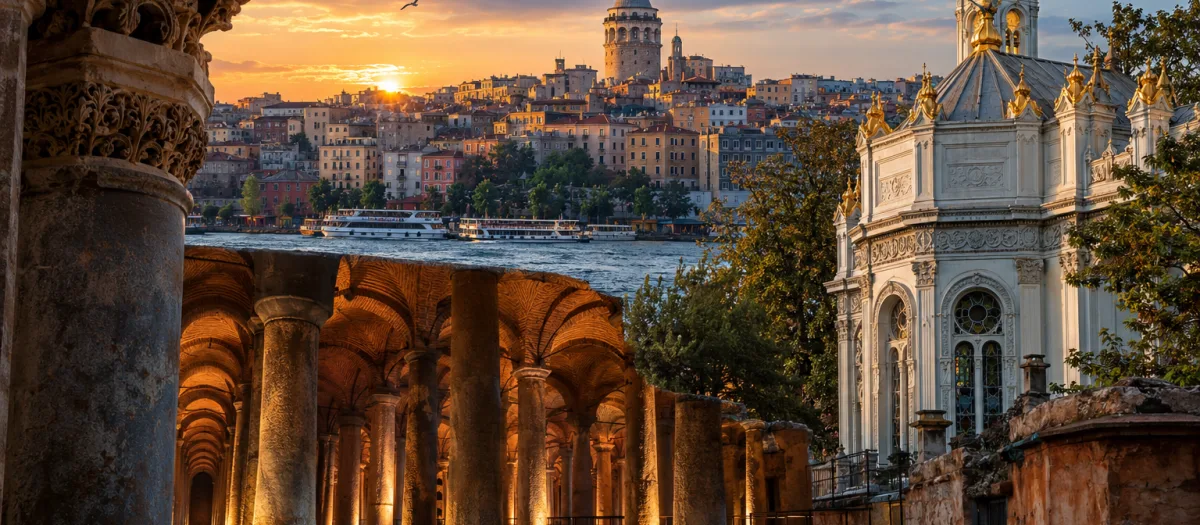
Basilica Cistern
Location: Sultanahmet, Fatih
Visiting days: Every day
Beneath the streets of Sultanahmet lies one of the most atmospheric surviving structures of Byzantine Constantinople.
The Basilica Cistern was constructed during the reign of Emperor Justinian I in the sixth century and formed part of the city's sophisticated water-storage system.
Hundreds of marble columns rise from the shallow water beneath the vaulted brick ceiling.
The two Medusa-head column bases are among its most famous features. Their precise origins remain uncertain, but they are generally believed to have been reused from an earlier Roman structure.
Because the cistern is a ticketed attraction, visitors should check the current entrance hours before arriving, particularly during public holidays or special events.
Hagia Sophia
Location: Sultanahmet, Fatih
Visiting days: Normally every day, with restrictions during prayer periods
Hagia Sophia is one of the most important surviving buildings of Byzantine history.
The present structure was completed in 537 during the reign of Emperor Justinian I and served for centuries as the cathedral of Constantinople.
After the Ottoman conquest in 1453 it became a mosque. It was converted into a museum in the twentieth century and today once again functions as a mosque.
For this reason, Hagia Sophia belongs to several chapters of Istanbul's history rather than to a single period.
Its enormous dome, Byzantine mosaics, marble surfaces and later Ottoman additions demonstrate how different periods of the city coexist inside one building.
Visitor access is generally available throughout the week, although access can be restricted during prayers, particularly around Friday noon prayer. Religious events can also affect visiting arrangements.
Visitors planning to explore the monument independently can see current options for Hagia Sophia entrance tickets and audio guides.
Hagia Irene
Location: First Courtyard of Topkapı Palace, Sultanahmet
Visiting days: Wednesday to Monday; closed Tuesday
Hagia Irene is particularly important because it was never converted into a mosque.
The church stands inside the outer grounds of Topkapı Palace and represents one of the oldest surviving Byzantine religious structures in Istanbul.
Its history reaches back to the early Christian period of Constantinople, although the present building reflects several phases of reconstruction.
Unlike many Byzantine churches in Istanbul, Hagia Irene preserves a relatively austere interior and gives visitors a very different impression from the more elaborate decoration of Hagia Sophia.
Access follows the visiting schedule of the Topkapı Palace complex. The palace and Hagia Irene are closed on Tuesdays.
A visit can easily be combined with the Istanbul Historical Tour with Hagia Sophia and Topkapi Palace.
Column of Constantine
Location: Çemberlitaş, Fatih
Visiting days: Every day
The Column of Constantine is one of the most important surviving monuments connected directly with the foundation of Constantinople.
It was erected in the fourth century following Constantine the Great's transformation of the city into the new imperial capital.
The column has survived fires, earthquakes and centuries of urban change.
Today it stands beside one of Istanbul's busiest tram routes in Çemberlitaş, only a short walk from Sultanahmet and the Grand Bazaar.
Because it is an outdoor monument, it can be viewed at any time.
Valens Aqueduct
Location: Fatih, near Atatürk Boulevard
Visiting days: Every day
The Valens Aqueduct is one of the most striking reminders of Roman engineering in Istanbul.
Completed during the fourth century, it formed part of the vast water-supply network that brought fresh water into Constantinople.
Modern traffic now passes directly beneath its surviving arches.
The aqueduct is not a conventional museum and therefore does not have standard entrance hours. It can be viewed from the surrounding public streets throughout the week.
Byzantine City Walls
The Theodosian Land Walls
Location: From the Golden Horn towards the Marmara Sea, Fatih and Zeytinburnu
Visiting days: Outdoor sections can be seen throughout the week
The land walls of Constantinople rank among the greatest surviving defensive structures of the ancient and medieval world.
Most of the monumental fortification system visible today developed during the reign of Emperor Theodosius II in the fifth century.
For approximately one thousand years these walls protected Constantinople against numerous sieges.
Visitors can still see long sections of towers, gates, brickwork and defensive walls stretching across the western side of the Historic Peninsula.
Some sections can simply be viewed from public streets and parks, while restored visitor areas may have their own opening schedules.
Belgradkapı Visitor Centre
One of the restored sections around Belgradkapı provides a particularly accessible way to understand the walls.
The visitor centre normally operates from Tuesday to Sunday and is closed on Monday. The official municipal information lists visiting hours of 10:00–18:00.
Travellers interested in combining the fortifications with another perspective on Istanbul can consider the Half-Day Istanbul Tour with Bosphorus Cruise and City Walls.
Genoese Heritage in Istanbul
Galata Tower
Location: Galata, Beyoğlu
Visiting days: Every day
Although towers existed in the wider area earlier, the present Galata Tower is primarily associated with the Genoese colony that flourished in medieval Galata.
The Genoese controlled an important commercial settlement on the northern shore of the Golden Horn and surrounded it with defensive walls.
The tower became the most recognisable surviving symbol of this medieval European presence in Constantinople.
Today it functions as a museum and panoramic viewpoint.
The Ministry of Culture currently lists Galata Tower as open every day, with daytime and separate evening museum sessions.
Galata is also one of the easiest areas in which to combine several different periods of Istanbul's non-Islamic history, with churches, synagogues and nineteenth-century European architecture all within walking distance.
Christian Heritage in Istanbul
Christian communities have been part of Constantinople and Istanbul for more than 1,600 years.
Greek Orthodox, Armenian Apostolic, Bulgarian Orthodox, Syriac and Roman Catholic institutions can still be found throughout the city.
Some are active places of worship rather than tourist attractions. Visitors should therefore dress respectfully, remain quiet during services and understand that opening hours may change according to religious ceremonies.
Ecumenical Patriarchate and Church of St George
Location: Fener, Fatih
The Ecumenical Patriarchate of Constantinople is one of the most important centres of Orthodox Christianity.
The present patriarchal complex is located in Fener, an area closely associated with Istanbul's historic Greek Orthodox community.
Within the complex stands the Patriarchal Church of St George.
Although the church is modest in scale compared with Hagia Sophia, its religious significance is considerable. The interior contains important icons, relics and ecclesiastical objects.
The Ecumenical Patriarchate remains an active religious institution, so visitors should check locally for ceremonies or temporary access restrictions before visiting. Its official address is Dr. Sadık Ahmet Caddesi No. 19 in Fatih.
Bulgarian St Stephen Church
Location: Balat, Fatih
Also known as the Bulgarian Iron Church, St Stephen stands beside the Golden Horn between Fener and Balat.
The church is remarkable because much of its structure was produced using prefabricated cast-iron components.
Its distinctive white exterior, richly decorated interior and waterfront position make it one of the most unusual churches in Istanbul.
It remains an active Bulgarian Orthodox church, and religious services can affect visitor access.
A visit can easily be combined with a walk through Fener and Balat, where Greek Orthodox, Bulgarian, Armenian and Jewish history overlap within a relatively small area.
Church of St Anthony of Padua
Location: İstiklal Avenue, Beyoğlu
Visiting days: Every day under normal circumstances
St Anthony of Padua is one of Istanbul's most prominent Roman Catholic churches.
The present neo-Gothic building was constructed in the early twentieth century and stands directly on İstiklal Avenue.
Although significantly younger than Istanbul's Byzantine monuments, it represents another important layer of the city's Christian and European history.
The church continues to hold regular services in different languages and is generally accessible throughout the week. Visitors should avoid disrupting Mass and other religious ceremonies.
Armenian Churches of Istanbul
Istanbul has been home to an important Armenian Christian community for centuries.
Historic Armenian churches can be found in districts including Kumkapı, Samatya, Balat, Üsküdar, Kadıköy and Beyoğlu.
Among the most significant institutions is the Armenian Patriarchate of Constantinople in Kumkapı.
Unlike large state museums, active Armenian churches may not operate according to fixed tourist schedules. Anyone planning a dedicated Armenian heritage route should therefore check individual church access before visiting.
Jewish Heritage in Istanbul
The Jewish history of Istanbul stretches back many centuries and became particularly significant after Sephardic Jews expelled from the Iberian Peninsula settled in Ottoman territories from the late fifteenth century onwards.
Galata, Hasköy, Balat, Kuzguncuk and other districts became important centres of Jewish life.
Today several historic synagogues and cultural institutions preserve this heritage.
Neve Shalom Synagogue
Location: Galata, Beyoğlu
Visiting days: Sunday to Friday; closed Saturday
Neve Shalom is one of the best-known synagogues in Istanbul and remains an active centre of Jewish religious life.
Public visits are organised through the adjoining Quincentennial Foundation Museum of Turkish Jews.
Current official visiting hours are Monday to Thursday from 10:00 to 17:00, Friday from 10:00 to 13:00 and Sunday from 10:00 to 17:00.
The complex is closed on Saturdays for Shabbat and may also close on national and Jewish religious holidays. Visitors must carry an official identity document or passport and pass through security before entering.
Quincentennial Foundation Museum of Turkish Jews
Location: Büyük Hendek Caddesi, Galata
Visiting days: Sunday to Friday; closed Saturday
Located alongside Neve Shalom Synagogue, this museum explains the history, traditions and daily life of Jewish communities in Türkiye.
Exhibitions cover subjects ranging from Sephardic migration and religious traditions to community life, music, ceremonies and relations with wider Turkish society.
Because the museum entrance is also used for visits to Neve Shalom, it is one of the most practical places for travellers who want to understand Jewish Istanbul in historical context.
The museum follows the same weekly visiting schedule as the synagogue and requires identification at the entrance.
Jewish Heritage in Balat and Hasköy
Balat and Hasköy once contained significant Jewish populations and numerous synagogues.
Some synagogues remain active, but access can be limited and security procedures are generally stricter than at conventional tourist attractions.
Visitors should not assume that every synagogue can be entered without advance arrangements.
Even without entering individual religious buildings, walking through these neighbourhoods provides an opportunity to understand how Jewish, Greek, Armenian and Muslim communities once lived alongside each other around the Golden Horn.
Istanbul Archaeological Museums
Location: Gülhane, Fatih
Visiting days: Every day
For travellers trying to understand Istanbul before and beyond the Ottoman era, the Istanbul Archaeological Museums are among the most important institutions in the city.
The museum complex contains collections from many ancient civilisations, including Greek, Roman, Anatolian, Mesopotamian and Near Eastern cultures.
The complex consists principally of the Archaeological Museum, Museum of the Ancient Orient and the Tiled Kiosk.
The official museum information currently lists the Istanbul Archaeological Museums as open every day. Some individual galleries may occasionally be unavailable because of restoration or exhibition work.
The museum is located close to Gülhane Park, Topkapı Palace, Hagia Irene and Sultanahmet, making it easy to include in a full historical day.
Princes' Islands and Istanbul's Christian Heritage
The Princes' Islands offer another side of Istanbul's multicultural history.
During the Byzantine period the islands were associated with monasteries, religious communities and exiled members of the imperial elite.
In later centuries, especially during the Ottoman period, Greek Orthodox, Armenian and Jewish communities played major roles in island life.
Büyükada and Heybeliada still preserve churches, monasteries, historic houses and streets with architecture very different from central Istanbul.
Büyükada
Büyükada is the largest of the Princes' Islands.
Historic Greek Orthodox churches, old mansions and former religious institutions form an important part of its character.
One of the best-known religious landmarks is the Church and Monastery of St George, known locally as Aya Yorgi, located on one of the island's highest points.
Heybeliada
Heybeliada also has a strong Greek Orthodox heritage.
The island is particularly associated with the historic Halki Theological School and the Monastery of the Holy Trinity.
Even when individual religious buildings have restricted access, the island itself provides a valuable perspective on Istanbul's Christian and multicultural history.
Visitors wanting to experience both major islands in one day can join the Princes' Islands Tour to Büyükada and Heybeliada.
A Suggested Route Through Non-Islamic Istanbul
It is impossible to cover every layer of Istanbul's Roman, Byzantine, Christian and Jewish heritage in a single day.
However, visitors can organise the sites geographically.
Day 1: Sultanahmet and Ancient Constantinople
Start around the former Hippodrome and see:
Morning
The Obelisk of Theodosius
The Serpent Column
The Walled Obelisk
Hagia Sophia
Basilica Cistern
Afternoon
Hagia Irene
Istanbul Archaeological Museums
Column of Constantine
This route concentrates almost entirely on Roman and Byzantine Constantinople.
Day 2: Fener, Balat and the Land Walls
Begin around the Golden Horn with:
Morning
Ecumenical Patriarchate
Church of St George
Bulgarian St Stephen Church
Historic streets of Fener and Balat
Afternoon
Theodosian Land Walls
Belgradkapı
Other restored wall sections
This route demonstrates how Byzantine, Greek Orthodox, Bulgarian, Armenian and Jewish histories overlap in western Istanbul.
Day 3: Galata and Beyoğlu
Explore:
Morning
Galata Tower
Neve Shalom Synagogue
Museum of Turkish Jews
Afternoon
İstiklal Avenue
Church of St Anthony of Padua
Historic European architecture of Beyoğlu
Galata and Beyoğlu are particularly useful for understanding the Genoese, Jewish and European chapters of Istanbul's history.
Which Sites Are Open Every Day?
Several important locations are normally accessible seven days a week.
Outdoor monuments such as the Hippodrome, Obelisk of Theodosius, Serpent Column, Column of Constantine, Valens Aqueduct and publicly accessible sections of the city walls can generally be viewed at any time.
Galata Tower and the Istanbul Archaeological Museums are currently officially listed as open every day.
Religious buildings require more flexibility because ceremonies, prayer times and religious holidays can affect tourist access.
Which Places Are Closed on Certain Days?
Some important sites have fixed weekly closure days.
Hagia Irene follows the Topkapı Palace schedule and is closed on Tuesday.
The Belgradkapı Visitor Centre at the Byzantine city walls is closed on Monday.
Neve Shalom Synagogue and the Museum of Turkish Jews are closed on Saturday for Shabbat and may also close for Jewish or national holidays.
Churches and active religious institutions can have separate schedules depending on services and religious celebrations.
Before Visiting Churches and Synagogues in Istanbul
Historical churches and synagogues are not simply monuments. Many remain functioning places of worship.
Visitors should therefore dress appropriately, speak quietly and avoid interrupting religious ceremonies.
Synagogues may require identification, security checks or advance arrangements.
Churches may temporarily restrict sightseeing during Mass, Divine Liturgy, weddings, funerals or other ceremonies.
Opening schedules can also change during Easter, Christmas, Jewish holidays and other religious observances.
Discovering the Other Layers of Istanbul
Istanbul cannot be explained through a single empire, religion or architectural tradition.
Roman engineering survives beneath modern streets. Byzantine churches stand beside Ottoman monuments. Genoese towers overlook the Bosphorus. Orthodox patriarchates, Catholic churches and synagogues continue traditions that have existed in the city for centuries.
Exploring these places provides a broader understanding of Constantinople and Istanbul as a city shaped by multiple peoples, religions and empires.
Travellers who prefer to explore with a guide can compare Istanbul daily tours, historical tours, Bosphorus cruises and cultural activities and combine organised sightseeing with independent visits to the city's lesser-known historical sites.
Because museum schedules, restoration projects and religious services can change, always check the current visiting conditions shortly before your visit.
-card.webp)