Topkapi Palace in Istanbul: The Heart of the Ottoman Empire
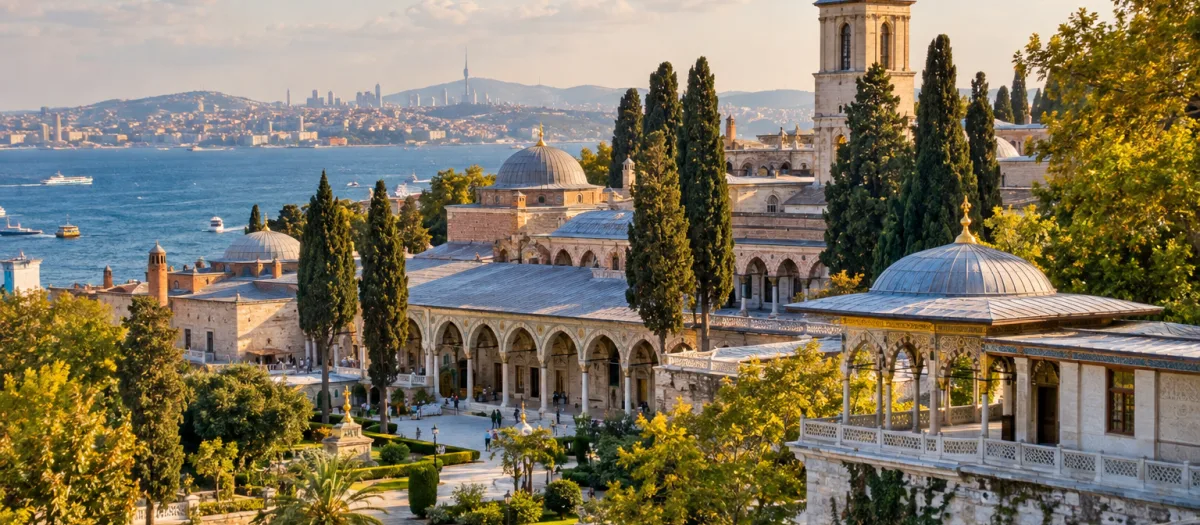
Topkapi Palace is one of the most important historical landmarks in Istanbul and one of the best places to understand the political power, daily life, traditions and culture of the Ottoman Empire. Standing on the historic peninsula between the Bosphorus, the Golden Horn and the Sea of Marmara, the palace served as the main residence and administrative center of the Ottoman sultans for almost four centuries.
Today, Topkapi Palace operates as a museum complex filled with imperial courtyards, ceremonial halls, treasury rooms, religious relics, gardens and private residential areas. Among all these sections, the Imperial Harem remains one of the most fascinating parts of the palace because it reveals a side of Ottoman court life that was largely hidden from the outside world.
Visitors planning to see more of Istanbul’s historic attractions can also browse daily tours and activities in Istanbul to combine Topkapi Palace with other important sights across the city.
A Brief History of Topkapi Palace
Topkapi Palace was commissioned by Sultan Mehmed II, known as Mehmed the Conqueror, after the conquest of Constantinople in 1453. Construction began in the second half of the 15th century, and the palace gradually expanded as successive Ottoman sultans added new buildings, chambers, courtyards and ceremonial spaces.
Unlike many European royal palaces built around a single monumental structure, Topkapi developed as a large complex composed of interconnected courtyards, pavilions and specialized buildings.
For centuries, it was not only the residence of the Ottoman dynasty but also the administrative center of one of the most powerful empires in the world.
The Palace as the Center of Ottoman Government
Topkapi Palace functioned almost like a small city. Thousands of people worked within the complex, including government officials, guards, cooks, servants, craftsmen, scholars and members of the imperial household.
Important state decisions were made here, foreign ambassadors were received here, and major ceremonies took place within the palace grounds.
The layout of the palace reflected the hierarchy of Ottoman society. The deeper a person entered into the complex, the more exclusive and restricted the surroundings became.
The Four Main Courtyards of Topkapi Palace
Topkapi Palace is organized around four principal courtyards, each serving a different purpose.
The First Courtyard
The First Courtyard was the most accessible section of the palace. It functioned as a transitional zone between the city and the imperial complex.
Visitors entering through the Imperial Gate reached this large open area, which contained service buildings and administrative structures.
The Church of Hagia Irene
One of the most significant buildings in the First Courtyard is Hagia Irene, a Byzantine church that survived the Ottoman conquest.
Unlike Hagia Sophia, Hagia Irene was never converted into a mosque. During the Ottoman period, it was used for different purposes, including the storage of weapons.
The Second Courtyard
The Second Courtyard was more controlled and was connected closely with the administrative life of the empire.
This section includes some of the palace's most recognizable structures, including the Imperial Council Chamber and the palace kitchens.
The Imperial Council
The Imperial Council, known as the Divan, was where senior government officials discussed matters concerning the empire.
The grand vizier and other important officials met here to discuss military campaigns, taxation, diplomatic affairs and administrative matters.
The sultan did not always attend directly. Instead, he could observe proceedings from a screened window above the chamber.
The Palace Kitchens
The enormous palace kitchens once prepared meals for thousands of palace residents and officials.
Today, these buildings are also known for collections of Ottoman and international porcelain, ceramics and tableware.
The Imperial Harem of Topkapi Palace
The Imperial Harem is one of the most misunderstood yet historically important areas of Topkapi Palace.
Popular culture often presents the Ottoman harem simply as a luxurious private space filled with women. In reality, the harem was a highly organized institution with strict rules, hierarchies, education systems and political importance.
The word "harem" comes from an Arabic root referring to something private, protected or forbidden to outsiders. In the context of the Ottoman palace, it represented the private residential section of the imperial family.
Who Lived in the Harem?
The harem was home to members of the sultan's immediate family and many members of the palace household.
Residents included the sultan's mother, wives and consorts, princes, princesses, female attendants, servants and eunuchs responsible for security and administration.
The number of people living inside the harem changed considerably depending on the period and the reigning sultan.
The Valide Sultan: The Most Powerful Woman in the Palace
One of the most important figures in the harem was the Valide Sultan, the mother of the reigning sultan.
When her son became sultan, the Valide Sultan usually became the highest-ranking woman in the imperial household.
She controlled significant parts of palace life and could possess considerable financial and political influence.
The Apartments of the Valide Sultan
The apartments of the Valide Sultan were among the most impressive sections of the harem.
They included reception rooms, private chambers and decorated interiors covered with İznik tiles, painted ceilings and intricate Ottoman designs.
The size and location of these rooms reflected her prestigious position within the dynasty.
The Sultan's Consorts
Women within the harem followed a strict hierarchy.
Some entered palace service at relatively low ranks and received training in areas such as palace etiquette, music, language, embroidery and household administration.
A woman who gained the attention of the sultan could rise within this hierarchy.
Some became influential consorts, while a woman who gave birth to a prince could obtain an even more important position.
The political influence of some Ottoman royal women became particularly visible during the period historians often call the "Sultanate of Women," when several women of the dynasty played notable roles in imperial politics.
Hürrem Sultan and the Transformation of the Harem
One of the most famous women associated with Ottoman palace history is Hürrem Sultan, known in many Western sources as Roxelana.
She became the wife of Sultan Suleiman the Magnificent and achieved an exceptionally influential position within the dynasty.
Her rise changed certain traditions of Ottoman court life and increased the political importance of women within the imperial household.
Hürrem Sultan is also associated with the gradual movement of the royal household toward Topkapi Palace, helping transform the palace harem into the primary residence of the imperial family.
The Princes of the Ottoman Dynasty
Ottoman princes also lived within sections of the palace complex.
Their lives were heavily controlled because succession to the throne was one of the most sensitive political issues in the empire.
In earlier centuries, princes were often sent to govern provinces as part of their political education.
Later, some princes spent long periods within palace apartments under close supervision.
The Cage System
The so-called "Kafes," or cage system, developed during later Ottoman history.
Under this system, potential heirs to the throne could remain inside palace quarters rather than governing provinces.
Although they lived in comfortable surroundings, their movements and political activities could be severely restricted.
The Black Eunuchs
The security and organization of the harem were closely connected to the black eunuchs.
They guarded entrances, controlled access and served as intermediaries between different parts of the palace.
The Chief Black Eunuch became an important court official and could exercise considerable influence because of his close access to the imperial family.
Daily Life Inside the Harem
Life inside the harem followed strict rules.
Residents did not simply spend their days in leisure. Education, religious instruction, household duties, palace ceremonies and formal etiquette were all important parts of daily life.
Young women entering palace service could receive years of training.
Those who did not remain within the imperial household permanently could eventually leave the palace, often with financial support and social connections that helped them establish new lives.
Architecture of the Harem
The architecture of the harem reflects both privacy and hierarchy.
Instead of consisting of one enormous hall, the area contains a complex network of corridors, courtyards, bedrooms, reception rooms, baths and private apartments.
As visitors move deeper into the harem, the rooms generally become more exclusive.
Courtyard of the Eunuchs
One of the first important areas is the Courtyard of the Black Eunuchs.
This courtyard formed part of the controlled entrance system of the harem and included living spaces for the guards responsible for protecting the private quarters.
Courtyard of the Queen Mother
The courtyard associated with the Valide Sultan was positioned deeper within the harem.
Its location illustrates the importance of the queen mother within the palace hierarchy.
Imperial Hall
The Imperial Hall was among the largest ceremonial spaces within the harem.
It was used for gatherings, celebrations, receptions and events involving members of the royal family.
The richly decorated interior demonstrates the wealth and artistic sophistication of the Ottoman court.
Twin Pavilions
The Twin Pavilions, associated with Ottoman princes, are another important architectural feature.
Their tiled walls, stained glass windows and decorated interiors provide visitors with a sense of how royal residential spaces were designed.
İznik Tiles and Ottoman Decoration
One of the most memorable features of Topkapi Palace is its decoration.
Walls throughout the complex are covered with magnificent examples of İznik tiles, especially in areas dating from the 16th and 17th centuries.
Traditional patterns include tulips, carnations, geometric forms, leaves and arabesque designs.
Many rooms also include mother-of-pearl details, carved wood, calligraphy, painted ceilings and decorative marble.
These elements make Topkapi Palace not only a historical monument but also an important showcase of Ottoman decorative arts.
The Imperial Treasury
The Imperial Treasury contains some of the most famous objects associated with the Ottoman dynasty.
Visitors can see ceremonial weapons, jewels, royal objects and valuable gifts presented to Ottoman rulers.
The Topkapi Dagger
The Topkapi Dagger is one of the palace's most recognizable treasures.
Its richly decorated handle and precious stones demonstrate the craftsmanship associated with Ottoman court objects.
The Spoonmaker's Diamond
Another famous object is the Spoonmaker's Diamond.
Its exact early history is surrounded by different stories, but it remains one of the most celebrated pieces in the palace collection.
Sacred Relics
Topkapi Palace also contains a collection of sacred objects connected with Islamic history.
These objects became particularly important after the Ottoman Empire expanded into the Middle East and the Ottoman sultans increasingly emphasized their role as protectors of important Islamic sites and traditions.
The Sacred Relics section has long held religious as well as historical significance.
Palace Gardens and Bosphorus Views
Topkapi Palace occupies one of Istanbul's most impressive locations.
From several terraces, visitors can see the Bosphorus, the Asian side of Istanbul, the Golden Horn and the Sea of Marmara.
These views were not simply decorative.
The palace's location allowed the Ottoman court to overlook some of the most strategically important waterways connecting Europe and Asia.
The Fourth Courtyard
The Fourth Courtyard contains elegant pavilions and landscaped terraces.
This area feels more intimate than the administrative courtyards and was designed largely for the private use of the sultan and members of the royal household.
Baghdad Pavilion
The Baghdad Pavilion was built during the reign of Sultan Murad IV.
Its interior contains fine tilework, calligraphy and traditional Ottoman decorative elements.
Revan Pavilion
The Revan Pavilion is another refined example of Ottoman palace architecture and was constructed to commemorate military achievements.
Visiting Topkapi Palace Today
A complete visit to Topkapi Palace can easily take several hours.
Travelers interested mainly in taking photographs and seeing the main courtyards can move through the palace relatively quickly, but anyone interested in Ottoman history should allow considerably more time.
The Harem deserves particular attention because it contains some of the palace's most impressive interiors and provides essential context for understanding the Ottoman dynasty.
Visitors exploring Istanbul's historic peninsula can also combine Topkapi Palace with other major landmarks and experiences through Istanbul tours and activities.
What to See Near Topkapi Palace
Topkapi Palace is located in Sultanahmet, where many of Istanbul's most important historical monuments are within walking distance.
Nearby attractions include Hagia Sophia, the Blue Mosque, Basilica Cistern, Hippodrome and Istanbul Archaeological Museums.
This concentration of monuments makes the historic peninsula one of the best areas for travelers who want to understand Istanbul's Byzantine and Ottoman past.
Why the Harem Is Essential to Understanding Topkapi Palace
The Harem should not be treated as a minor side section of Topkapi Palace.
It was one of the central institutions of the Ottoman dynasty.
Family relationships, succession, education, household administration and political influence were all connected to the people who lived within its walls.
Its architecture also provides some of the finest examples of Ottoman interior decoration found anywhere in Istanbul.
Walking through its narrow corridors, tiled chambers, courtyards and royal apartments offers a very different perspective from the ceremonial spaces of the palace.
Instead of focusing only on sultans, military campaigns and government institutions, the harem reveals the private world behind the Ottoman throne.
Topkapi Palace as a Window into Ottoman Istanbul
Topkapi Palace is much more than a former royal residence.
It represents centuries of political power, family life, court culture, architecture, religion and artistic production.
From the Imperial Council and Treasury to the peaceful gardens overlooking the Bosphorus, every section reveals a different layer of Ottoman history.
The Imperial Harem adds another dimension by showing how the dynasty lived away from public ceremonies and government affairs.
For travelers interested in understanding Istanbul beyond its famous skyline, Topkapi Palace remains one of the city's most rewarding historical sites.

-card.webp)