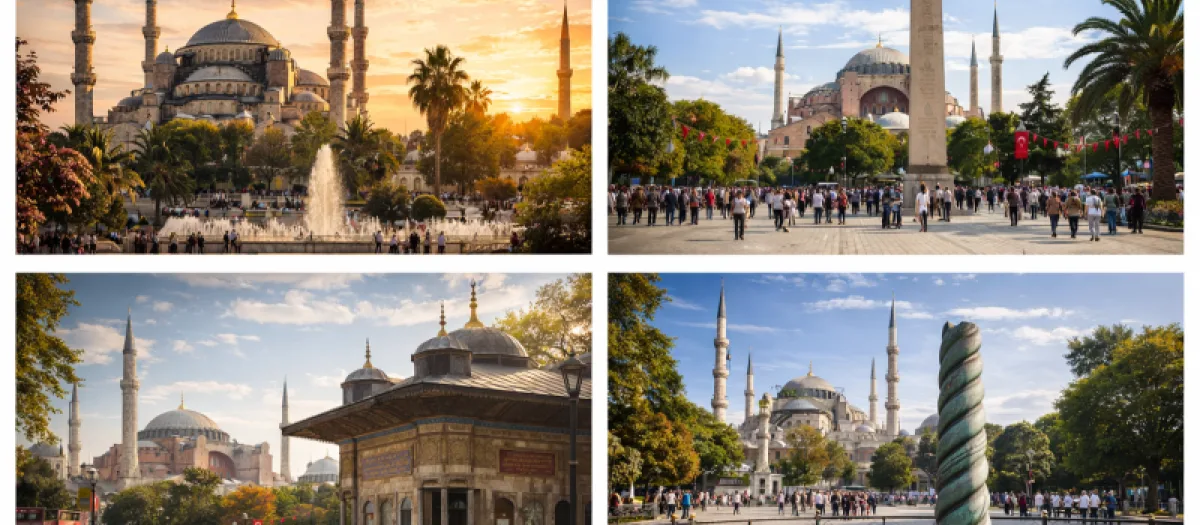
Sultanahmet Square: Where Istanbul’s History Breathes in the Open Air
In the heart of Istanbul, there is a place where time does not rush —
it simply unfolds.
Sultanahmet Square is one of the city’s most familiar yet most layered spaces,
where every step falls quietly beside centuries of memory.
It stands between the footprints of empires,
but it carries this weight with a calm, steady presence.
Here, history is not displayed behind glass.
It lives outdoors, under daylight,
in stone, in silence, and in the rhythm of passing people.
The Ancient Hippodrome: The First Layer Beneath the Square
Long before it became an open public space,
this area was the Hippodrome of Constantinople —
the monumental arena of the Roman and Byzantine capital.
Technical details:
-
Length: approx. 480 meters
-
Width: approx. 120 meters
-
Capacity: 40,000–50,000 spectators
-
Built: originally by Septimius Severus, expanded by Constantine the Great
-
Function: chariot races, imperial ceremonies, public gatherings
The arena is gone, yet its outline still shapes the square today.
The gentle curve of the ground, the long axis,
and the alignment of monuments quietly reveal the Hippodrome’s original form.
A structure may disappear, but its geometry often stays.
The Egyptian Obelisk: The Oldest Witness of the Square
Standing tall in the center is the Egyptian Obelisk,
carved around 3,500 years ago during the reign of Pharaoh Thutmose III.
It once rose beside the Nile before it traveled through centuries
to reach Constantinople in the 4th century.
Technical details:
-
Age: approx. 3,500 years
-
Height: 25 meters
-
Weight: over 200 tons
-
Material: pink granite
-
Brought to Istanbul: MS 390, under Emperor Theodosius I
Its hieroglyphs remain sharp despite the ages.
The stone seems to hold its own time —
slow, patient, and uninterrupted.
The Serpent Column: A Quiet Spiral from the Ancient World
Nearby stands the Serpent Column,
a simple bronze spiral that carries a distant memory.
It was originally created to celebrate the Greek victory over Persia
at the Battle of Plataea in 479 BC
and placed at the Temple of Apollo in Delphi.
Technical details:
-
Made of intertwined bronze serpents
-
Originally had three serpent heads (now missing)
-
Brought to Constantinople by Constantine the Great
Today only the coiled body remains,
yet even this fragment reflects the long path the monument has traveled.
The Walled Obelisk: A Remnant of Imperial Ceremony
The Walled Obelisk, restored in the 10th century by Emperor Constantine VII,
rises at the opposite end of the square.
Technical details:
-
Height: approx. 32 meters
-
Structure: cut stone blocks
-
Originally covered with gilded bronze plates
-
Surface stripped during the Fourth Crusade
Its current plain surface carries the marks of time.
It is not decorative, but it is honest —
a straightforward piece of the Hippodrome’s spine.
The Blue Mosque: Light, Space, and a Calm Sense of Grandeur
On the eastern side of the square stands the Sultan Ahmed Mosque,
known worldwide as the Blue Mosque.
Completed between 1609 and 1617,
it remains one of the most graceful examples of Ottoman architecture.
Technical details:
-
Architect: Sedefkâr Mehmed Ağa
-
Minarets: 6
-
Main dome diameter: 23.5 m
-
Dome height: 43 m
-
Interior: over 20,000 İznik tiles
-
Windows: more than 260 openings for natural light
The interior is spacious and calm.
Blue tones reflect soft daylight, creating a quiet and balanced atmosphere.
It is impressive without trying to be overwhelming.
Hagia Sophia: The Stone Depth Opposite the Square
Just a short walk from the square rises Hagia Sophia,
one of the world’s most influential architectural works.
Its presence gives Sultanahmet a deeper and broader historical dimension.
Technical details:
-
Built: 537, under Emperor Justinian
-
Dome diameter: 31 m
-
Interior height: 55.6 m
-
Architectural style: a blend of basilica and central-plan design
-
Materials: marble, porphyry, columns from ancient temples
Hagia Sophia is both monumental and grounded.
From the square, it appears almost timeless —
as if it belongs to every era at once.
The German Fountain: A Small Memory at the Square’s Edge
At the northern end stands the German Fountain,
a gift from Kaiser Wilhelm II in 1901.
Though modest in size, it adds a clear architectural note to the area.
Details:
-
Octagonal plan
-
Green domed roof
-
Golden mosaics inside
-
Neo-Byzantine design
It marks the early 20th century’s connection between Istanbul and Europe.
Sultanahmet Square Today: A Living Part of the Historic Peninsula
Today the square is:
-
one of Istanbul’s most visited open areas,
-
part of the UNESCO Historic Areas of Istanbul,
-
a starting point for the city’s major historic landmarks,
-
a wide pedestrian zone with long sightlines and open air.
The atmosphere changes throughout the day:
-
Morning: soft light, slower footsteps, quieter surroundings
-
Midday: a blend of languages, visitors, and movement
-
Afternoon: long shadows, warm light on stone surfaces
-
Night: a calmer square, monuments softly illuminated
The rhythm is steady and fluid, like the city itself.
Conclusion: A Square That Holds History Without Forcing It
Sultanahmet Square carries many stories,
but it does so without exaggeration.
Its monuments are not loud;
they simply remain where they have always stood,
each one adding a different layer to the area:
-
the Hippodrome beneath the ground,
-
the Obelisk reaching upward,
-
the Serpent Column’s spiral,
-
the Walled Obelisk’s worn stone,
-
the Blue Mosque’s light,
-
Hagia Sophia’s depth,
-
the German Fountain’s quiet ornament.
Together, they form a place that is both historic and alive —
a square where the past is not frozen,
but gently present in the open air.
Useful Link for Tours in Sultanahmet and Istanbul
After exploring the historic atmosphere of Sultanahmet Square, you may want to discover the deeper layers of Istanbul. This page brings together a wide selection of daily tours and activities — from Bosphorus cruises to guided walks through the old city — offering visitors a complete view of Istanbul’s cultural and historical richness.
Istanbul Daily Tours & Activities:
https://vigotours.com/things-to-do/daily-tours-activities/istanbul-turkey/all-categories


-card.webp)