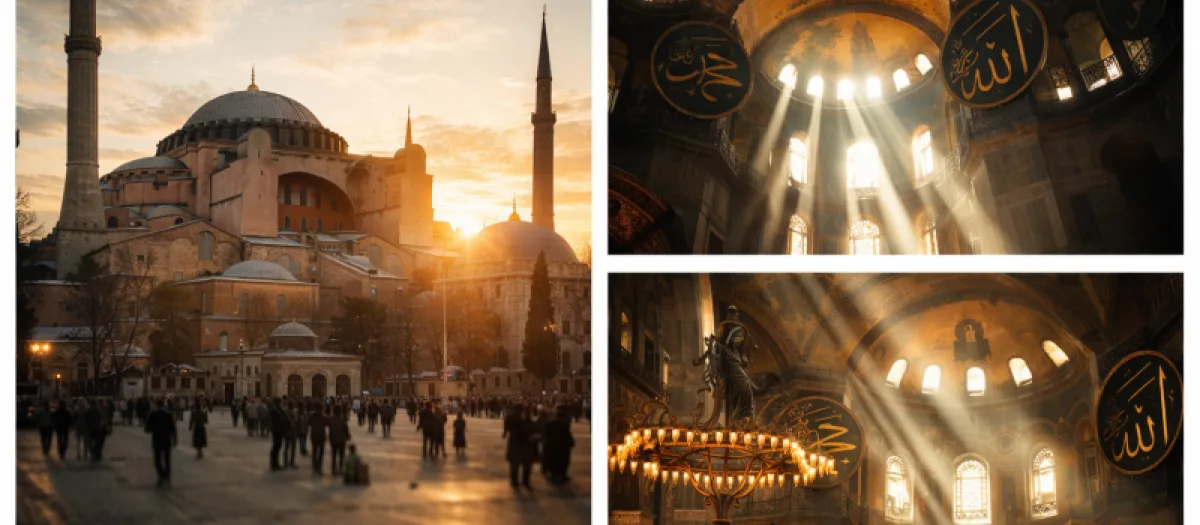
Hagia Sophia: Where Stone, Light, and Silence Become Memory
In the heart of Istanbul, where continents meet and centuries fold into one another, a structure rises with quiet majesty. Hagia Sophia…
Not merely a building, but a vast chamber of memory—where empires breathed, faiths shifted, and time itself learned to whisper. Here, even stone seems alive; marble remembers, granite murmurs, and the great dome inhales like a calm, immovable sky.
As you approach Hagia Sophia, the noise of the city dissolves as if out of respect. Crowds instinctively soften their voices. Because this is not a place you simply enter; it is a threshold that carries you into a different dimension—one shaped by history, light, architecture, and a strange, timeless serenity.
The Dance of Light
Inside Hagia Sophia, light behaves unlike anywhere else.
At dawn, a soft gold settles across the marble floors, slipping between the colossal columns. The mosaics—those tiny tesserae laid by craftsmen nearly fifteen centuries ago—begin to glow, a delicate shimmer that once symbolized the divine light descending upon earth.
By noon, light climbs higher, circling the dome, touching the veins of ancient marble slabs. Even the stones change character with the hours: gentle at sunrise, dramatic at midday, contemplative as evening approaches.
At sunset, everything turns to amber. Shadows stretch across the nave. The building grows heavier, almost meditative. Visitors slow their steps without realizing why—perhaps because, in that moment, they feel history pressing its palm against their shoulder.
The Dome: A Silent Sky
Hagia Sophia’s dome is not just an architectural feat; it is a miracle of imagination.
With its 31-meter diameter placed 55 meters above the ground, it was, in 537, a revolution of engineering and vision.
Its construction introduced innovations centuries ahead of their time:
-
The pendentive system, allowing a circular dome to rise over a square base.
-
Massive foundations spreading the immense weight across the earth.
-
Special lightweight bricks enabling the dome to span a vast space while keeping its structure resilient.
This dome endured earthquakes, invasions, restorations, and storms.
It did not surrender.
Its survival is a reminder of how human creativity sometimes outlives the very civilizations that birthed it.
Empires Hidden in the Walls
Look closely at Hagia Sophia’s walls, and you see more than mosaics.
You see entire empires.
For nearly a thousand years, Hagia Sophia was the spiritual heart of the Byzantine world, where emperors were crowned, and the echoes of the empire’s rites filled the air.
Then came 1453. Mehmed the Conqueror entered the city and transformed the church into a mosque—preserving it, not erasing it.
Minarets rose; a mihrab was placed; the building gained new layers, new meaning. Mimar Sinan—perhaps the greatest architect of the Ottoman world—reinforced the buttresses, ensuring the dome would stand against future centuries.
In the 20th century it became a museum.
In the 21st, it returned to use as a mosque.
Yet through all these transformations, one truth remained: Hagia Sophia never belonged to a single era. It has always belonged to humanity.
The Silence That Speaks
Hagia Sophia is never fully silent, yet the silence it holds feels dense—full rather than empty.
The breath of centuries clings to its walls.
It changes the way you stand, the way you breathe, the way you listen.
Here, silence has weight.
It settles on your shoulders gently, like the memory of a long-forgotten story.
You walk slowly, not because you must, but because the space itself invites contemplation. Every footstep becomes an echo of thousands who walked here before you.
You do not simply observe Hagia Sophia; you participate in its memory.
Architecture as a Living Organism
Hagia Sophia is not a static monument.
It feels alive—an organism made of stone, light, and geometry.
Some of its extraordinary technical details:
-
107 columns, some sourced from ancient temples in Ephesus and Egypt.
-
Opus sectile marble panels, mirrored like inkblots, turning geology into art.
-
The monumental Imperial Door, forged of bronze and ancient timber.
-
A remarkable acoustic resonance, allowing chants to hang in the air long after the voices stop.
-
Forty windows at the dome’s base, creating an illusion that the dome floats on a ring of light.
The building reads like a manuscript in stone: every part a paragraph, every detail a line of poetry written by engineers, artists, and emperors.
What Hagia Sophia Leaves in the Human Heart
Everyone who steps inside Hagia Sophia feels something different.
For some, it is the weight of history.
For others, the brilliance of architecture.
For many, it is simply a quiet transformation—an unexpected moment of clarity or emotion.
Hagia Sophia deepens you.
Your voice lowers, your pulse softens, and the modern world fades.
It becomes not just a place you visit, but a place that visits you.
Conclusion: A Monument That Remembers
Hagia Sophia is more than a masterpiece; it is a witness.
Empires rose and fell. Borders shifted. Languages vanished.
Yet this great structure remained, guarding the memory of all it has seen.
With its dome like a captured sky,
its marble like frozen rivers,
its silence like a hymn that never ends…
Hagia Sophia is humanity’s shared legacy—
a reminder that beauty can survive everything,
and that the human spirit endures, stone by stone, century after century.
Useful Links for Hagia Sophia and Istanbul Tours
If you would like to explore more information about Hagia Sophia, including visit details and ticket point information, please visit:
Hagia Sophia Ticket & Visitor Information:
https://vigotours.com/istanbul-turkey/hagia-sophia-ticket-sales-point
To discover daily tours, guided experiences, and activities in Istanbul:
Istanbul Daily Tours & Activities:
https://vigotours.com/things-to-do/daily-tours-activities/istanbul-turkey/all-categories


-card.webp)