Derinkuyu Underground City – The Mysterious World Beneath Cappadocia
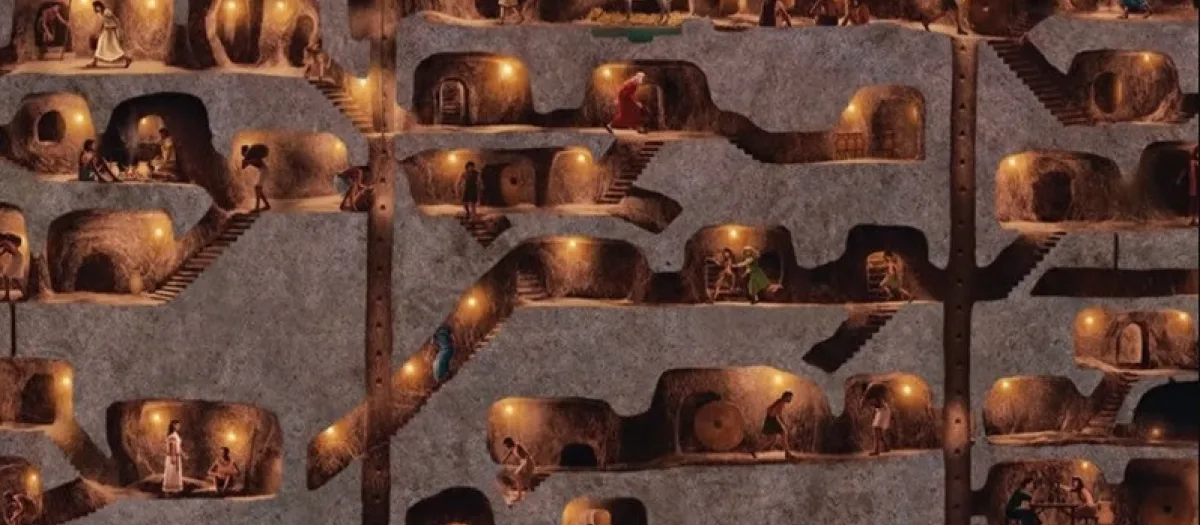
Derinkuyu Underground City is one of Cappadocia’s most extraordinary and mysterious attractions. Descending 85 meters below ground, this vast subterranean complex once sheltered up to 20,000 people, complete with living quarters, churches, schools, storage rooms, and an advanced ventilation system. It is a powerful symbol of human resilience, survival, and ancient engineering brilliance.
Unlike Cappadocia’s famous fairy chimneys and valleys, Derinkuyu reveals a hidden civilization that chose safety beneath the earth rather than life above it.
Discover the Hidden Depths of Derinkuyu
When visiting Cappadocia, the experience is not complete without going underground. Derinkuyu is the largest of the 36 known underground cities in the region and offers a rare glimpse into how entire communities lived in secrecy for centuries.
The city is commonly included in popular sightseeing routes such as the Cappadocia Green Tour or Cappadocia Red Tour, making it easy to combine with valleys, churches, and panoramic viewpoints.
While Cappadocia is famous for its rock formations and cave churches, Derinkuyu stands apart as a fully functional underground city built for long-term survival.
Why Visit Derinkuyu Underground City?
Step Into Ancient History
Derinkuyu is believed to have been first carved around 3000 BC, with major expansions during the Byzantine period. Early Christians enlarged the tunnels to protect themselves from invasions and religious persecution, creating a secure underground refuge.
Ingenious Engineering
The city’s design is remarkably advanced.
More than 50 ventilation shafts supply fresh air to the deepest levels, while underground wells ensured access to clean drinking water. The system was so effective that fires could be lit underground without suffocating residents.
Spiritual and Cultural Significance
Hidden chapels, a cross-shaped church, and the famous Missionary School reveal the spiritual life of the community. These sacred spaces were used for worship, education, and gatherings, offering deep insight into early Christian life in Cappadocia.
Impressive Scale and Defense
Derinkuyu could house around 20,000 inhabitants, and connected tunnels may have allowed up to 50,000 people to shelter during emergencies. Massive round stone doors, some weighing up to 500 kg, could be rolled into place to block intruders.
What to See Inside Derinkuyu Underground City
Today, eight levels are open to visitors, each serving a specific purpose:
1st Floor
Stables, kitchens, and basic storage areas reflecting daily life underground.
2nd Floor
Large storage rooms used to preserve grain and food supplies.
3rd Floor
The Missionary School and the central ventilation hub of the city.
4th Floor
A heavily protected area with defensive traps and a dungeon.
5th Floor
Administrative rooms where leadership and planning took place.
6th Floor
Security chambers and additional storage spaces.
7th Floor
The largest section, featuring a hall, cemetery, and a private water well.
8th Floor
Compact chambers connected directly to critical ventilation shafts.
Visitors interested in more cave settlements and hidden valleys can also explore nearby routes such as Soganli Valley or the Cappadocia South Tour.
How to Visit Derinkuyu Underground City
Location
Derinkuyu is located about 30 km from Nevşehir. It can be reached easily by car or as part of organized tours, including the Cappadocia Blue Tour.
Entrance Fee
-
13€ per person
-
Müzekart: Valid for two visits per year
-
Müzekart+: Unlimited access
Opening Hours
-
April – October: 08:00 – 19:00
-
November – March: 08:00 – 17:00
-
Closed until 13:00 on the first day of religious holidays
Best Time to Visit
Spring and autumn are ideal due to mild weather. The underground temperature remains around 13°C year-round, making it comfortable even in summer.
Travel Tips for Exploring Derinkuyu
-
Wear comfortable shoes: Floors can be uneven and slippery
-
Dress appropriately: Cool underground temperatures are constant
-
Be prepared for narrow spaces: Some tunnels are low and tight
-
Bring a small light: Certain areas are dimly lit
-
Hire a guide: A knowledgeable guide adds historical depth and context
After your visit, consider relaxing in a Traditional Turkish Bath or exploring Cappadocia’s landscapes with a Hot Air Balloon Ride, Jeep Safari, or Horseback Riding Tour.
Fascinating Facts and Legends
-
Advanced ventilation: Over 50 shafts supply oxygen throughout the city
-
Stone defense doors: Circular stones sealed corridors from the inside
-
Self-sufficient life: Residents could live underground for months
-
Mysterious legends: Some myths suggest divine or even extraterrestrial involvement
-
Connected underground network: Tunnels link Derinkuyu to other cities like Kaymakli
Derinkuyu Underground City – Frequently Asked Questions (FAQ)
1) What is Derinkuyu Underground City?
Derinkuyu is a vast, multi-level underground settlement located in Cappadocia, Türkiye. It is not just a network of tunnels; it includes living quarters, storage rooms, stables, religious spaces, and defensive systems, all designed for long-term underground living.
2) How old is Derinkuyu Underground City?
Derinkuyu is believed to be around 5,000 years old. The earliest excavations date back to ancient times, while major expansions occurred during the Byzantine period. The city evolved gradually over centuries rather than being built all at once.
3) How deep is Derinkuyu?
The known depth of Derinkuyu is approximately 85 meters (280 feet). Not all levels are open to visitors, but descending deeper clearly reveals the scale and atmosphere of the underground structure.
4) How many levels does Derinkuyu have?
Derinkuyu is thought to extend down up to 18 levels. Today, around 8 levels are open to the public due to safety and preservation concerns.
5) Why was Derinkuyu built?
Its primary purpose was to serve as a safe refuge during invasions and periods of danger. Cappadocia’s soft volcanic rock (tuff) made it possible to create large underground spaces suitable for long-term shelter.
6) Who lived in Derinkuyu?
It was used by different communities over time. While early local populations may have begun the excavation, early Christian communities significantly expanded and systematically organized the city.
7) How many people could live there?
Derinkuyu is estimated to have accommodated up to 20,000 people, supported by food storage areas, water sources, and tunnel connections.
8) Is Derinkuyu the largest underground city in Cappadocia?
Yes. It is considered one of the largest and deepest underground cities in the Cappadocia region.
9) How was air supplied underground?
Clean air and smoke ventilation were provided through more than 50 ventilation shafts, which made extended underground living possible.
10) Does the ventilation system still work?
Yes. Natural air circulation can still be felt today, especially as cool airflow in certain areas.
11) How was water supplied?
Water was obtained through underground wells and carefully planned access to natural water sources, making water security a core part of the design.
12) Were the wells connected to the surface?
Some wells were not directly connected to the surface, reducing the risk of poisoning or outside interference.
13) What were the stone doors used for?
Large circular stone doors were used to block corridors during danger, isolating sections of the city as part of its defense system.
14) How heavy were the stone doors?
Some doors weighed around 500 kg (1,100 lbs). They could be closed easily from the inside but were extremely difficult to open from outside.
15) Are there religious structures inside?
Yes. Derinkuyu contains chapels, worship areas, and larger religious spaces, reflecting the spiritual needs of underground life.
16) What is the Missionary School?
It is a large hall and room complex believed to have been used for religious education, gatherings, and community organization.
17) Is Derinkuyu safe to visit?
Yes, visitor routes are clearly defined. However, narrow corridors and steep stairs require caution and slow movement.
18) Are the passages narrow?
Yes. Some corridors are quite narrow, both for defensive purposes and due to the nature of rock excavation.
19) Is it suitable for people with claustrophobia?
It may be challenging. Low ceilings, narrow corridors, and limited lighting can be uncomfortable. Taking breaks in wider areas is recommended.
20) Can children visit?
Yes, but adult supervision is essential. Some stairs are steep, and ceilings can be low.
21) How long does a visit take?
Most visits last 45 minutes to 1.5 hours, depending on crowd levels and walking pace.
22) What is the temperature inside?
The temperature stays around 13°C (55°F) year-round. It feels cool in summer and mild in winter. A light jacket is recommended.
23) Is special clothing required?
No special clothing is needed, but comfortable clothes and non-slip shoes are strongly advised.
24) Is the lighting sufficient?
There is lighting along visitor routes, though some areas remain dim. It may take a few minutes for eyes to adjust.
25) Can you take photos?
Yes. Photography is allowed, but visitors should avoid blocking narrow passages and use flash sparingly.
26) Are there stairs?
Yes, many of them. Some stairs are steep, so using handrails and moving slowly is important.
27) Is it suitable for disabled visitors?
Unfortunately, no. Narrow corridors and steps make it unsuitable for wheelchairs or limited mobility.
28) Is Derinkuyu connected to other underground cities?
It is believed to be connected by tunnels to other cities, particularly Kaymaklı, though most connections are not open to visitors.
29) When was it discovered?
It was rediscovered in 1963, after a hidden passage was found during a house renovation.
30) Is it part of UNESCO World Heritage?
Yes. Cappadocia is a UNESCO World Heritage Site, and Derinkuyu is an important part of this cultural landscape.
31) What type of rock was it carved into?
It was carved into tuff, a soft volcanic rock ideal for excavation.
32) How long could people stay underground?
With food storage, water supply, and ventilation, people could stay underground for weeks or even months.
33) Were animals kept underground?
Yes. Stables were located on upper levels, which helped manage air circulation and odors.
34) How was food stored?
Food was kept in cool, dry storage rooms. The stable underground temperature helped preserve supplies longer.
35) Did it have a defense system?
Yes. Narrow corridors, stone doors, and controlled access points formed an effective defensive layout.
36) Were there toilets and waste systems?
Yes. Waste management areas were included to support sustainable underground living.
37) Was it used continuously?
No. It was actively used during different periods over thousands of years, depending on historical conditions.
38) Are there written records?
Written sources are limited. Most information comes from archaeological, architectural, and geological studies.
39) How was smoke removed?
Smoke was directed outward through the ventilation shafts.
40) Was fire used underground?
Yes, under controlled conditions. The ventilation system made limited fire use possible.
41) Is it suitable for elderly visitors?
It can be physically demanding. Slow movement and visiting during less crowded hours are recommended.
42) Are there emergency exits?
The city was designed with multiple exit concepts. Today, visitor routes include modern safety guidance.
43) Is it open all year?
Generally yes, though opening hours may vary by season or special holidays.
44) What is the entrance fee?
€13 per person
Prices are set by the Turkish Ministry of Culture and Tourism and may change.
Is Museum Pass valid?
Yes, for Turkish citizens.
Museum Pass+ allows unlimited entry.
Can foreigners use Museum Pass?
The standard pass is not valid. Foreign visitors can purchase the Museum Pass+ for foreigners.
45) Are there information panels inside?
Yes, basic information panels are available, though prior reading enhances the experience.
46) Is there humidity inside?
Humidity is generally moderate and may vary by season.
47) Is touching the walls allowed?
Touching is discouraged to protect the fragile tuff rock.
48) Are research studies ongoing?
Yes. Scientific research on Cappadocia’s underground cities continues.
49) What makes Derinkuyu special?
Its depth, scale, engineering solutions, and fully functional underground living system built thousands of years ago.
50) Why is Derinkuyu important today?
Derinkuyu offers a rare insight into how ancient societies organized, survived crises, and engineered complex solutions underground. It is a unique historical and engineering heritage site.
Cappadocia Tours and Experiences
Cappadocia Red Tour
Discover the most famous landmarks of Cappadocia, including fairy chimneys, rock-cut churches, and panoramic viewpoints.
https://vigotours.com/cappadocia/cappadocia-red-tour
Cappadocia Green Tour
Explore the lush valleys, underground cities, and historical sites of southern Cappadocia on a full-day guided tour.
https://vigotours.com/cappadocia/cappadocia-green-tour
Cappadocia Blue Tour
Visit lesser-known but equally impressive areas of Cappadocia, offering deeper cultural and natural insights.
https://vigotours.com/cappadocia/cappadocia-blue-tour
Cappadocia South Tour
A comprehensive tour focusing on the southern region, including scenic valleys and ancient settlements.
https://vigotours.com/cappadocia/cappadocia-south-tour
Cappadocia Soganli Valley Tour
Experience the peaceful Soganli Valley, known for its rock-cut churches and traditional village atmosphere.
https://vigotours.com/cappadocia/cappadocia-soganli-valley-tour
Guided and Specialty Cappadocia Tours
Cappadocia Tour with Japanese Speaking Guide
Enjoy a private or small-group Cappadocia tour led by a professional Japanese-speaking guide.
https://vigotours.com/cappadocia/cappadocia-tour-with-japanese-speaking-guide
Outdoor and Adventure Activities in Cappadocia
Horseback Riding Tour in Cappadocia
Ride through Cappadocia’s valleys and unique landscapes on a guided horseback experience.
https://vigotours.com/cappadocia/horseback-riding-tour-in-cappadocia
ATV Quad Safari Cappadocia
Explore off-road trails and valleys with an exciting ATV quad safari adventure.
https://vigotours.com/cappadocia/atv-quad-safari-cappadocia
Cappadocia Jeep Safari Tour
Discover remote areas and panoramic viewpoints with a guided 4x4 jeep safari.
https://vigotours.com/cappadocia/cappadocia-jeep-safari-tour
Cultural and Evening Experiences in Cappadocia
Traditional Turkish Night Show in Cappadocia
Experience traditional Turkish music, folk dances, and cultural performances in a lively evening show.
https://vigotours.com/cappadocia/traditional-turkish-night-show-in-cappadocia
Traditional Turkish Bath Experience in Cappadocia
Relax and unwind with an authentic Turkish bath experience after a day of sightseeing.
https://vigotours.com/cappadocia/traditional-turkish-bath-experience-in-cappadocia
Iconic Cappadocia Experiences
Cappadocia Hot Air Balloon Ride
Enjoy a sunrise hot air balloon flight over fairy chimneys and valleys for an unforgettable experience.
https://vigotours.com/cappadocia/cappadocia-hot-air-balloon-ride
Cappadocia Tours FAQ
1) How long do Cappadocia tours usually last?
Most daily tours last between 6 and 8 hours. Activities like balloon rides or ATV tours are shorter.
2) Is hotel pickup included in Cappadocia tours?
Yes, most tours include hotel pickup from Göreme, Ürgüp, Avanos, and Uçhisar.
3) What is the difference between Red, Green, and Blue Tours?
The Red Tour covers iconic sites, the Green Tour focuses on valleys and underground cities, and the Blue Tour explores quieter areas.
4) Are Cappadocia tours suitable for children?
Yes, daily tours are family-friendly. Some adventure activities may have age limits.
5) Are hot air balloon flights guaranteed?
Flights depend on weather conditions. If canceled, refunds or rescheduling are offered.
6) Are the tours guided?
Yes, tours are led by licensed professional guides. Some are available in multiple languages.
7) Is lunch included in the tours?
Most full-day tours include lunch, while activity tours may not.
8) Are Cappadocia tours available year-round?
Yes, tours operate all year, though winter schedules may vary.
9) Are ATV and Jeep Safari tours safe?
Yes, safety equipment and professional guidance are provided.
10) Should Cappadocia tours be booked in advance?
Advance booking is recommended, especially for balloon rides and popular tours.