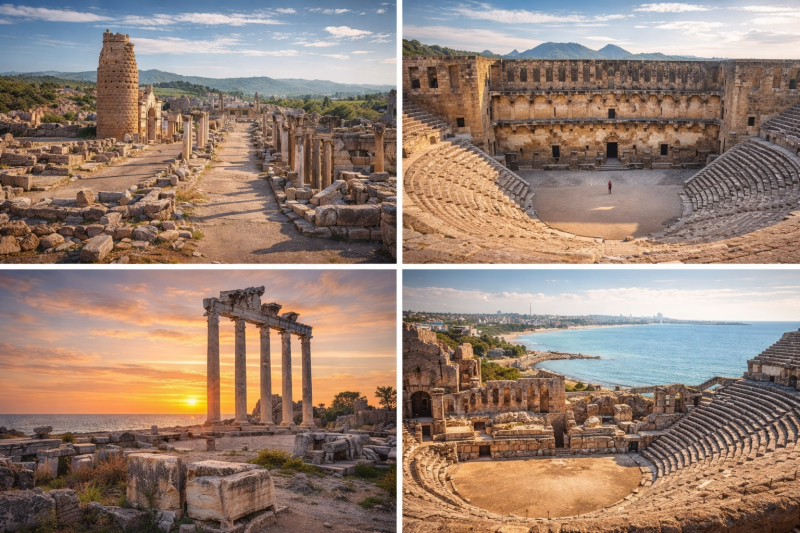
Perge, Aspendos and Side emerge as a living memory, where theatres echo, columns breathe and the sea completes an ancient rhythm.
Perge, Aspendos and Side: Reading Ancient Pamphylia Through Space, Sound and Sea
The ancient cities of Perge, Aspendos, and Side form one of the most meaningful historical routes in southern Anatolia. Rather than repeating the same story, each city represents a different response to geography, power, and time. Understanding them together allows a deeper reading of how ancient societies lived, governed, and eventually faded.
Why Are Perge, Aspendos and Side Considered a Single Historical Route?
These cities developed within the same cultural region—Pamphylia—yet followed different paths shaped by environment and purpose. Their closeness allows comparison rather than repetition.
- Perge explains how a planned city functioned internally
- Aspendos demonstrates authority through engineering and sound
- Side reveals how trade, belief, and memory converge at the sea
Perge: What Does an Organized Ancient City Look Like?
Urban Planning and Daily Movement
Perge was not built organically but designed deliberately. Wide colonnaded streets, public squares, baths, a stadium, and a theatre were positioned to regulate movement and social interaction. The city’s north–south axis structured daily life and procession.
The Role of Water in Perge
Water flowed visibly through the main street, fed by mountain springs. This was both practical and symbolic: water represented continuity, control, and civic pride. Unlike hidden systems, Perge displayed its infrastructure openly.
Social Structure and Public Identity
Inscriptions and monuments show strong civic participation. Notably, women held visible public roles, including benefaction and restoration projects. Perge presents a city where identity was shared rather than imposed.
Aspendos: How Did Architecture Control Sound and Crowds?
The Theatre as a Political Statement
The Aspendos Theatre is not simply well preserved—it is precisely calculated. Built in the 2nd century AD, it reflects Roman mastery over acoustics, geometry, and audience control. Sound travels without amplification, even to the highest tiers.
Why Acoustics Matter Historically
In the ancient world, sound meant authority. A voice that could reach thousands without strain symbolized control. Aspendos demonstrates how architecture amplified not only performances but political power.
Infrastructure Beyond the Theatre
Aspendos survived due to its aqueduct system, including inverted siphons rarely seen elsewhere. These systems supplied baths and fountains reliably, proving the city valued sustainability as much as monumentality.
Looking for more unforgettable evening experiences in Turkey? Discover the spectacular Fire of Anatolia show in Antalya with hotel transfer and experience one of the world’s most famous Turkish dance performances at the historic Aspendos Ancient Theater.
Side: How Does a Harbor City Remember Itself?
Life Shaped by the Sea
Side occupied a narrow peninsula, making the sea central to its economy and identity. Trade routes brought wealth, people, and ideas—but also darker histories, including slavery. The city absorbed all layers without erasing them.
The Agora and Human Silence
Side’s agora was a commercial center, but also a place where human lives were traded. This duality—beauty and discomfort—defines Side more than any monument.
Theatre, Temples, and Emotional Space
Unlike Aspendos, Side’s theatre feels inward and restrained. Nearby, the Temples of Apollo and Athena face the sea. At sunset, architecture yields to light and silence, creating reflection rather than spectacle.
Book your Fire of Anatolia Aspendos tickets online with hotel transfer included.
How Do These Cities Complement Each Other?
Perge explains structure. Aspendos demonstrates mastery. Side preserves memory. Together, they describe a complete cycle: organization, dominance, and quiet withdrawal.
Is This Journey About Seeing Ruins or Understanding Systems?
The true value lies in recognizing ancient cities as systems—of water, sound, belief, and movement. Stones are not isolated objects; they are parts of functioning environments.
For contextual information about how these three cities form a connected historical route starting from Antalya, further reference is available here: Perge, Aspendos and Side historical route from Antalya .
Frequently Asked Questions
Why are Perge, Aspendos and Side often grouped together?
They belong to the same ancient region but represent different urban responses to geography and power.
Is this route repetitive for visitors?
No. Each site offers a distinct experience—planned order, acoustic mastery, and emotional reflection.
Do you need prior historical knowledge?
No. Spatial experience and atmosphere communicate meaning even without academic background.
Why is Aspendos Theatre still functional today?
Its engineering precision and structural integrity allow performances without modern technology.
What makes Perge different from other Roman cities?
Its preserved layout and visible infrastructure provide rare insight into daily urban life.
Is Side only important because of its seaside location?
No. Its layered religious, commercial, and social history adds depth beyond its harbor.
How physically demanding is this journey?
Moderate walking on uneven stone surfaces is required. Proper footwear and sun protection are advised.
What emotions do visitors commonly describe?
Reflection, calm, and a sense of continuity rather than excitement or spectacle.
Can these sites be visited independently?
Yes, but without context their deeper connections are often overlooked.
What is the ideal season for visiting?
Spring and autumn offer comfortable temperatures and better light for observation.
What stays with visitors after the journey?
An understanding that ancient cities were living systems, not silent ruins.