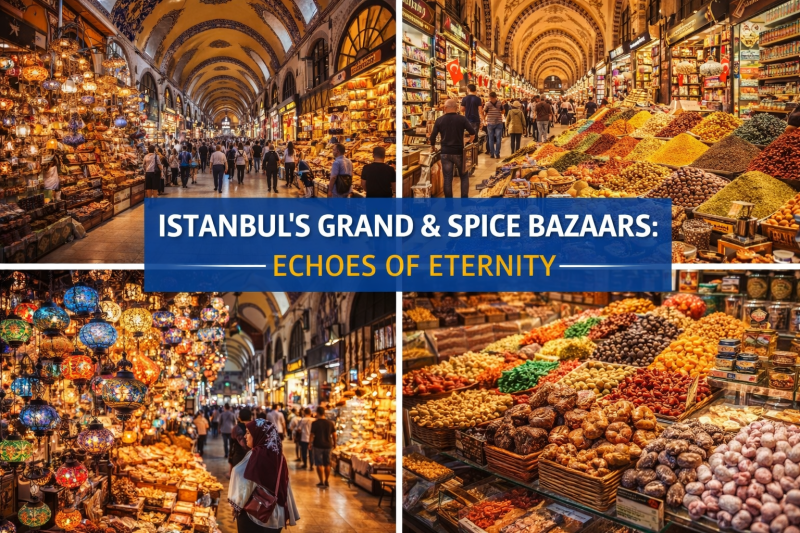
Walk through the Grand Bazaar’s golden maze and the Spice Bazaar’s fragrant corridors. Discover Istanbul’s living history, where scents, stones, and stories never fade.
Where Stones Speak: A Journey Through Istanbul’s Grand Bazaar and Spice Bazaar
Istanbul
A city where two continents touch
and time forgets to move.
Where the sea whispers stories
and stone remembers every footstep.
Here, the past walks beside you—
and the future waits in the light.
The Grand Bazaar — The Pulse of a City That Never Stops Remembering
There are corners of Istanbul where the city’s breath deepens,
where the air feels older, heavier, almost aware of its own history.
Walk through the alleys between Beyazıt and Nuruosmaniye,
and you will eventually stand before a gate that does not shout,
does not boast, does not beg for your attention—
yet pulls you in with an invisible force.
This is how one enters the Grand Bazaar.
“Some places do not invite you; they choose you.”
Cross the threshold and the light shifts instantly.
The bright sun outside dissolves into warm shades of amber,
sliding across 64 narrow streets like liquid gold.
The air tastes of old stone, polished metal, woven wool—
the residue of centuries of hands, trades, and breaths.
Founded in 1461, expanded through fires and restorations,
the Bazaar now holds nearly 4,000 shops under its sprawling roofs.
It opens its eyes at 09:00,
closes them at 19:00,
refusing to work on Sundays as if even history needs a day of silence.
But here, time does not pass.
It circulates.
A jeweler sets a ring beneath the light;
the gold glows with a pride older than the empire that shaped it.
A carpet dealer unrolls a Kilim whose colors whisper
mountain winds, forgotten villages, long-lost prayers.
In an antique stall, a copper bowl casts back a reflection that is not entirely yours—
as if it remembers every face that has leaned over it.
“In the Grand Bazaar, objects are not sold; they reveal themselves.”
The deeper you walk, the more the Bazaar rearranges you.
Your steps fall into its ancient rhythm;
your senses widen;
your thoughts quiet.
The Bazaar is a labyrinth, yes—
but one that loses only those who refuse to feel.
Let yourself drift, and suddenly you are in the Bedesten,
the oldest chamber,
a stone-walled echo of the 15th century
beating beneath the modern city like a buried drum.
At midday, light filters through small openings above,
touching metal, wool, leather, and glass.
The entire market glows like an orchestra warming up—
thousands of details tuning themselves into harmony.
Speak to any merchant and history becomes a face:
wrinkled hands polishing silver,
careful fingers tying knots in silk,
a voice telling you that this shop belonged to his grandfather,
and his grandfather’s grandfather before him.
“Tradition is not something preserved here; it is something breathed.”
And when the shutters begin to close
and the hum settles into a tired heartbeat,
you walk back toward the gate—
not realizing until you step outside
that the Bazaar has taken a small piece of you
and left something heavier, older, more luminous in return.
“You do not remember the Grand Bazaar.
The Grand Bazaar remembers you.”
The Spice Bazaar — Where the City Speaks in Scents
There are places in Istanbul where sound shapes the streets;
but in Eminönü, it is scent that leads the way.
As you approach the waterfront,
the wind brings salt from the Golden Horn,
the ferries sigh against the docks,
and the cries of seagulls slice through the sky—
yet beneath all of this,
a deeper, richer fragrance rises.
Warm cinnamon.
Sharp black pepper.
Honey-glazed figs.
A distant echo of saffron—
ancient, commanding, unmistakable.
Follow that aroma,
and you will arrive at the curved archways of the Spice Bazaar,
built in 1664,
breathing for more than three and a half centuries
without missing a single heartbeat.
“Some markets sell goods.
This one sells memories.”
Walk inside, and light behaves differently.
It bends between the stone vaults,
brushes the shelves,
and settles on pyramids of spices that look like colored sand
collected from forgotten worlds.
The Bazaar opens around 08:30 and closes near 19:00,
though its pulse feels constant,
as if shutting the doors only traps the scents inside
to let them ferment overnight.
Along the central corridor,
the air is a tapestry woven from continents.
Saffron from Iran glows like captured sunset.
Pul biber from Anatolia crackles with red heat.
Turmeric from India rests like powdered dawn.
Dried apricots, pistachios, rose teas,
the sweetness of lokum dusted in sugar—
it is impossible to tell where the world ends
and Istanbul begins.
“Here, the nose becomes a storyteller.”
A merchant waves you closer.
He lifts a jar of sumac,
sprinkles a small ruby-colored heap onto his palm,
and tells you how this spice
once traveled by caravan,
crossing deserts and empires
before finding a home beneath these vaulted ceilings.
In another stall,
a woman arranges fresh figs with such precision
that it feels like watching a ceremony.
Her family has stood behind this counter for decades.
Generations have learned this same choreography:
weighing, scooping, slicing, offering—
not just food, but heritage.
Deeper inside,
the corridors narrow.
The scents concentrate.
And suddenly you realize the Bazaar is guiding you,
the way a story guides its reader.
A stall of herbal teas glows with violet blossoms and emerald leaves.
The merchant explains, with soft expertise,
how each blend carries a purpose—
sleep, energy, healing, nostalgia.
“Not every remedy is swallowed;
some are inhaled.”
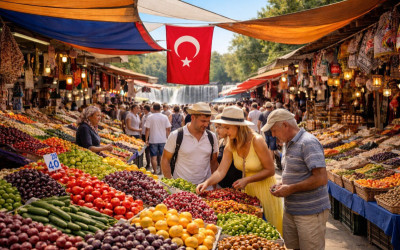
Turn left and you’ll find mountains of nuts glistening under warm lamps—
hazelnuts from the Black Sea,
walnuts from the high Anatolian plateau,
almonds roasted until they whisper.
Turn right and you’ll enter the sweet section,
where lokum—Turkish delight—
sits in soft, fragrant blocks
dusted like first snow.
Here, sweetness is not simply a flavor;
it is a cultural inheritance.
By midday,
the light from the waterfront finds its way into the Bazaar,
igniting the spices into glowing embers.
The colors look alive—
as if the reds breathe,
the yellows radiate,
the greens murmur.
You stand still for a moment,
and the entire space seems to pulse around you.
“The Spice Bazaar is not visited.
It is experienced.”
Tourists wander with slow curiosity,
locals move with confident precision,
and merchants—
the true guardians of this place—
watch everyone with the calm patience
of those who have seen centuries come and go.
Some markets change with fashion.
Some markets chase modernity.
But the Spice Bazaar holds its ground—
older than most countries,
younger than eternity,
a fragrant bridge between the past and whatever future Istanbul dreams next.
When you finally step outside,
the cool air of Eminönü hits your face.
But something inside you remains warm—
a lingering sweetness on your tongue,
a faint glow in your chest,
and the unmistakable impression
that the Bazaar has claimed a place within you.
“You leave the Spice Bazaar,
but its scent leaves you slowly.”
In the End, Istanbul Remains
And so you step out of the bazaars—
from the gold-lit corridors of the Grand Bazaar,
from the fragrant pulse of the Spice Bazaar—
back into the wide, breathing city.
Yet something follows you.
A shimmer of old light clings to your hands,
a trace of saffron lingers on your breath,
and the murmur of forgotten centuries
settles quietly in your chest.
For Istanbul does not simply show itself.
It marks you—
in scents, in echoes, in the weight of stories
that do not belong to you,
yet somehow now live within you.
You came as a visitor,
you leave as a witness.
And long after you have gone,
when the memory of your footsteps has faded from the stones,
the city will still whisper your name—
because no one truly leaves Istanbul.
They only carry it onward into the world.
Frequently Asked Questions
What do the Grand Bazaar and the Spice Bazaar represent for Istanbul?
They represent Istanbul’s living memory. Beyond commerce, these bazaars carry centuries of daily life, human movement, craftsmanship, and cultural exchange.
Why is the Grand Bazaar so significant?
The Grand Bazaar is one of the rare urban spaces where life has continued without interruption for centuries. The continuity of trades and shops turns it into a place where time accumulates.
How does the Spice Bazaar differ from the Grand Bazaar?
The Spice Bazaar is more sensory and instinctive. Smells, colors, and sounds dominate the experience, preserving sensory memory rather than architectural memory.
Are these bazaars only places for shopping?
No. They are also spaces for social interaction, cultural transmission, and everyday life. People come not only to buy, but to meet, talk, work, and belong.
Why do bazaars play such a central role in Istanbul’s identity?
Istanbul has always been a city of trade and passage. Bazaars became natural meeting points for different cultures, languages, and traditions, shaping the city’s character.
How do these spaces affect the perception of time?
Past and present exist simultaneously in the bazaars. Centuries-old shops stand beside modern life, creating a layered sense of time rather than a linear one.
What kind of relationship exists between people and these places?
People shape the space through daily use, while the space shapes people through memory, routine, and atmosphere. Over time, both leave marks on each other.
Why are these bazaars described as living spaces?
Because they are not static. They change daily, absorb human presence, and continuously carry the past into the present.
Why are bazaars essential to understanding Istanbul?
Because the city’s rhythm, culture, and collective memory are most clearly visible in these shared spaces.
What do these places leave behind in people?
A sense of familiarity, emotional weight, and quiet closeness — the feeling that certain places carry parts of us long after we leave.
Istanbul Tours: Where Every Step Becomes a Story
“In Istanbul, even time stops to listen.”
Discover the most exciting ways to explore Istanbul
Bosphorus cruises, historic city tours, cultural experiences, and professionally guided day trips help you see the city’s top sights comfortably and enjoyably.
Vigo Tours
https://vigotours.com/things-to-do/daily-tours-activities/istanbul-turkey/all-categories