Detailed Istanbul Guide to the Golden Horn Sirkeci and Galata Bridge
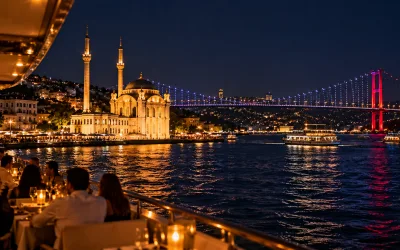
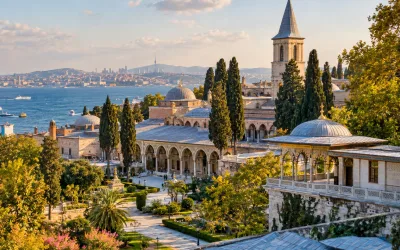
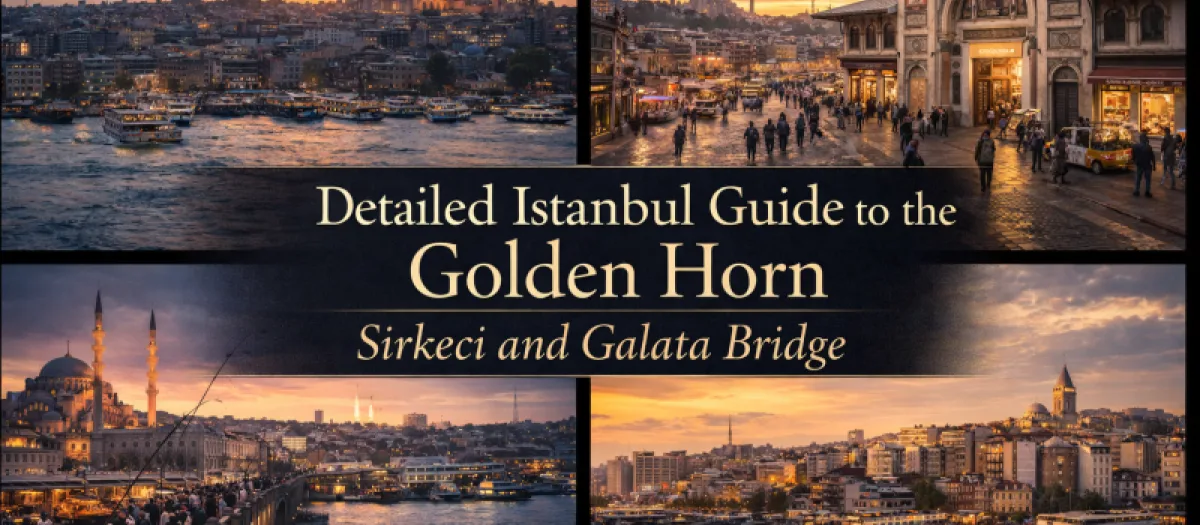
The Golden Horn, Sirkeci and Galata Bridge bring together three parts of Istanbul’s history: a sheltered harbour, a railway gateway and a busy crossing between neighbourhoods. Seen together, they explain how the city grew around the movement of ships, goods and people. They also make a rewarding route for a walk, with time to watch the waterfront rather than simply pass through it.
The Golden Horn: a harbour that shaped the city
Known in antiquity as Chrysokeras, the Golden Horn offered sheltered water beside the historic city. Its position made it important to Byzantine trade and defence. Docks, storage areas and maritime activity developed around a harbour whose entrance could be closed with a defensive chain.
The waterway belongs to the story of Constantinople’s sieges, including the Fourth Crusade in 1204 and the Ottoman conquest in 1453. The familiar account of Mehmed II’s ships being moved overland into the Golden Horn describes a way around the harbour barrier.
Under Ottoman rule, shipbuilding and workshops became central to the waterfront. The imperial shipyard developed on the northern shore around Kasımpaşa, with warehouses, docks and the trades needed to supply a fleet. Later industry, roads, parks and cultural spaces added further layers. The Golden Horn was never only a scenic backdrop: it was a working part of the city.
Sirkeci: from trading district to railway gateway
Sirkeci sits beside the historic peninsula’s transport and trading routes, close to Eminönü. The ancient Harbour of Theodosius was elsewhere on the peninsula: its remains were found at Yenikapı on the Marmara shore.
The landmark Sirkeci station building opened in 1890 and was designed by August Jasmund. Railway activity in the district had begun earlier. Its decorative masonry, arched openings and coloured glass give the façade an Orientalist character.
As the Istanbul terminus associated with the Orient Express, Sirkeci became a symbol of European rail travel reaching the Ottoman capital. The building’s appeal is both architectural and human: it is easy to imagine the arrivals, departures and waiting that once filled the halls. Check current access before planning an interior visit, rather than assuming every historic space is open.
Galata Bridge: successive crossings of the same water
The bridge links Eminönü and Karaköy. Both ends are on Istanbul’s European side. Its history is a sequence of replacements rather than one structure surviving unchanged.
- 1845: the first Galata Bridge was built in wood under the patronage of Bezm-i Âlem Valide Sultan.
- 1863: a replacement answered the needs of the growing city.
- 1912: a German-built bridge became a familiar feature of late Ottoman and Republican Istanbul; it was badly damaged by fire in 1992.
- Early 1990s: the present crossing entered service. Roughly 490 metres long, it has an opening central section for marine passage and a lower level with businesses and restaurants.
The engineering is only part of the experience. Anglers line the railings, people hurry towards the ferries and traffic crosses behind them. At sunset, the view towards the historic peninsula changes with the light. Stay aware of fishing lines and other pedestrians when stopping for photographs.
Along the shores: Fener, Balat and Eyüp
Following the historic peninsula’s shore inland brings Fener and Balat into the picture. Their streets, places of worship and trading history recall the Greek, Jewish and Armenian communities that helped shape the wider waterfront. Across the inlet, the shipyard districts tell a different story of labour and maritime industry.
Further towards Eyüp, the Eyüp Sultan mosque and the tomb of Abu Ayyub al-Ansari give the area a religious importance distinct from the commercial waterfront. Ottoman sultans held sword-girding ceremonies here after accession. Treat the complex as a place of worship, not merely another stop for photographs.
A route with room to pause
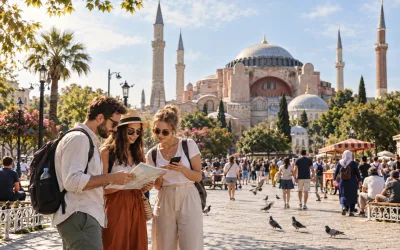
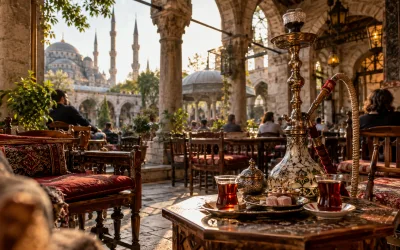
Begin around Sirkeci, continue towards Eminönü and cross to Karaköy. From there, the streets climb towards Galata Tower. A longer Golden Horn visit can include Fener, Balat or Eyüp, but these are separate extensions rather than a single short stroll. Choose the shore and stops you want, check transport connections, and leave time for tea by the water.