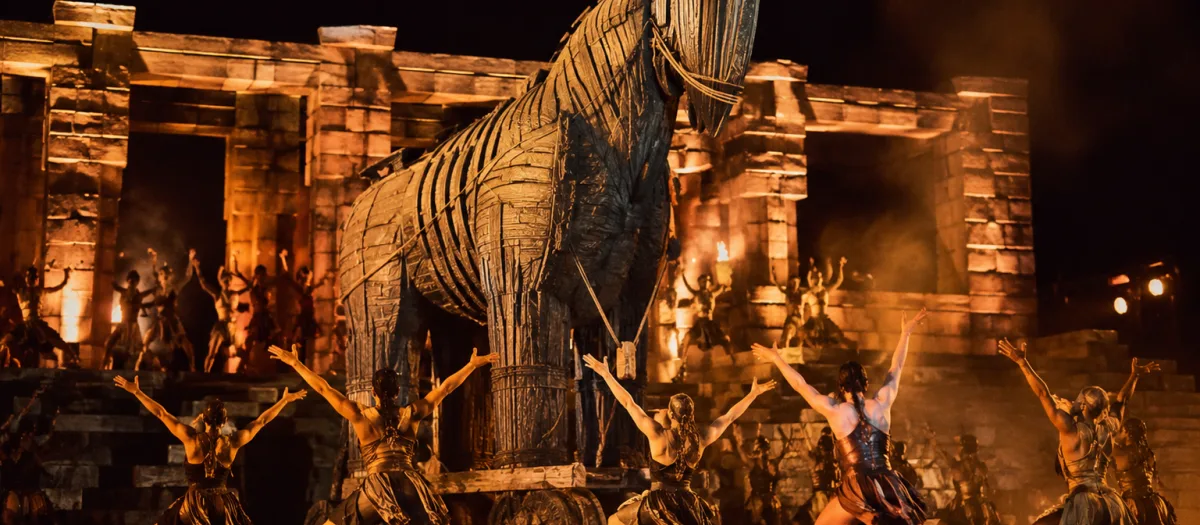
Troy Dance Show at Aspendos: the show and the 2026 announcement
Mustafa Erdoğan’s Troy tells the Trojan War legend through dance, music and visual storytelling. This article originally announced Tuesday performances at Aspendos from August 2026; that seasonal announcement is not a current weekly timetable. Confirm the date, venue and availability before planning a new visit.
The Story Behind the Troy Dance Show
The production is inspired by the legendary Trojan War, a story that has influenced literature, theatre, art and cinema for centuries.
At the centre of the legend are familiar figures such as Paris, Helen, Hector and Achilles. Their choices lead to love, conflict, loyalty, revenge and tragedy. The war between Troy and the Greek forces eventually results in one of mythology’s most famous deceptions: the Trojan Horse.
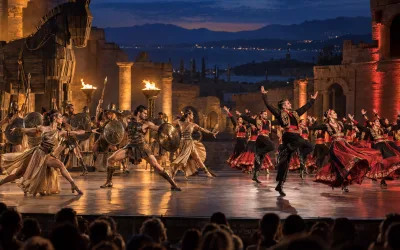
Troy transforms these events into a large-scale dance theatre production. Rather than presenting the legend through long conversations, the story develops through movement, music, battle scenes, costumes and visual symbolism.
The human cost of war
Alongside battles and famous heroes, the production follows grieving families, loss and the fall of a city. The archaeological site of Troy lies in today’s Çanakkale in northwestern Türkiye; Aspendos is a different ancient site near Serik. By drawing on Anatolian dance and music, the show connects the legend with the region where Troy stood.
Troy and Fire of Anatolia: two distinct productions
Mustafa Erdoğan, founder and artistic director of Fire of Anatolia, created Troy as a separate production. Fire of Anatolia explores dances from across Anatolia; Troy follows one continuous story with its own characters, music, costumes and dramatic structure.
Traditional Dance Meets Modern Stagecraft
The choreography combines elements of Anatolian folk dance, modern dance and ballet. Large groups move across the stage in carefully organised formations, while individual performers represent important characters from the legend.
The production uses contrasting styles to create different emotions. Energetic group sequences communicate the scale of war, while slower movements are used during scenes of love, mourning and loss.
Music, Costumes and Visual Design
Music plays a central role in guiding the audience through the story. Rhythmic sections accompany the battle scenes, while atmospheric melodies support quieter and more emotional moments.
Costumes are designed to suggest the ancient world without turning the performance into a conventional historical reconstruction. Flowing fabrics, armour-inspired details, helmets and symbolic colours help distinguish different characters and groups.
The visual presentation also includes dramatic lighting, large scenic elements and the unmistakable image of the Trojan Horse.
Following the story without Turkish dialogue
The show relies mainly on movement, music and visual symbols rather than lengthy spoken scenes. Knowing the main characters can help, but Turkish is not needed to follow the central conflict and emotions.
Travel options from Antalya’s resort areas
For hotel pickup details in and around Antalya, see Troy Dance Show from Antalya. Confirm the selected performance and transport arrangements before booking.
Aspendos is located near Serik, between Antalya and Side. Its position makes the theatre accessible from several major resort areas along the Mediterranean coast.
Guests staying near Belek are among the closest to the theatre. Details for the Troy Dance Show from Belek reflect the shorter journey between the Belek region and Aspendos.
Visitors staying further east can find regional transport information for the Troy Dance Show from Side and the Troy Dance Show from Alanya.
For holidaymakers on the western side of Antalya, the Troy Dance Show from Kemer includes arrangements based on the longer route from Kemer to Aspendos.
Ticket-Only Attendance
Not every visitor requires organised transportation. Travellers with a rental car, private driver or independent travel plan may prefer admission without a hotel transfer.
A separate Troy Dance Show ticket without transfer is available for guests who plan to reach the Ancient Theatre of Aspendos independently.
This distinction is useful because the journey time and overall evening schedule can vary considerably depending on the hotel location.
What to expect at Aspendos
The Roman theatre’s monumental stage building, semicircular stone rows and open sky give the performance its setting. Unlike a modern auditorium, it has stone seating, steps and uneven surfaces. Choose comfortable clothing and shoes, and allow time for entry and finding your seat.
Evening Conditions at the Theatre
Summer days in Antalya can be extremely hot, but temperatures usually become more comfortable after sunset. The open-air structure allows the evening atmosphere to remain part of the experience.
Although the performance takes place during the summer season, weather conditions can still vary. Visitors may find that a light outer layer is useful during breezy evenings, especially for those arriving from hotter coastal areas.
Arrival and Seating
The historical layout includes stone steps and uneven surfaces. Arriving with enough time before the performance allows visitors to enter the theatre calmly and locate their seating area without rushing.
Guests travelling with young children, older family members or people with reduced mobility should also consider the physical characteristics of the ancient venue when planning the evening.
Related travel guides
Aspendos Opera and Ballet Festival 2026 Program Announced · Troy vs Fire of Anatolia: A Complete Show Comparison
Related tours and transport guides
Find additional details in these articles: The Land of Legends: Water, Light and Night Show Magic.